Vitalik Buterin Says Ethereum Should Focus on Value, Not Fee Burns

Cryptocurrency trading is speculative and your capital is at risk when you trade. We may earn affiliate commissions from some of the products on this page - at no extra cost to you.

Highlights:
- Ethereum co-founder says ETH should gain value from network security and stability, not transaction burns.
- Vitalik Buterin believes that burning transaction fees will not offer a stable price floor for ETH, but he is in favor of maintaining EIP-1559. He warns that higher fees could undermine decentralization and increase the costs for users to use Ethereum.
Ethereum co-founder Vitalik Buterin believes ETH should focus on becoming a reliable store of value (SoV) rather than depending on transaction fee burns to support its price. He argues that Ethereum’s long-term value comes from its decentralization, security, and ability to operate without interference. But he is in favor of maintaining the current fee-burning system, but does not anticipate it will decide the value of ETH.
Advertisement

In a November 8 post on X, Buterin explained why he favors treating ETH as a store of value rather than a fee-burning token. He outlined three reasons, including weaknesses in the fee-burning model and the risks of prioritizing network revenue over decentralization.
Expanding on why I believe "ETH as store of value (SoV)" makes much more sense to focus on than "ETH as fee-burning token".
Three primary reasons:
1. ETH as fee-burning token never was as strong as it seemed
2. Optimizing for ETH as fee-burning token would demand Ethereum and…— vitalik.eth (@VitalikButerin) November 8, 2026
Buterin Says Ethereum Fee Burns Cannot Support ETH Price Alone
Buterin questioned the long-held argument that burning transaction fees creates a reliable price floor for Ethereum. Under the EIP-1559 upgrade introduced in 2021, Ethereum permanently removes the base fee from circulation. The mechanism can reduce ETH’s overall supply when the network burns more tokens than it issues.
However, Buterin argued that high fee burns do not necessarily guarantee lasting demand for ETH. He pointed to the 2021–2023 period, when speculative cryptocurrency trading and NFT activity drove much of Ethereum’s transaction revenue. During one major NFT sale, users paid around $180 million in fees in a single day.
Buterin said that revenue depended heavily on activity within the cryptocurrency market. When trading slowed, the fees also declined. He argued that Ethereum could attract more stable demand through tokenized real-world assets, although such activity may not generate the same high transaction fees.
Despite his criticism, Buterin does not want Ethereum to remove EIP-1559. “EIP-1559 (including its burn) is fine and good, we should keep them,” he wrote. He added that ETH holders should not worry even if fee burns permanently remain below 10% of the amount needed to offset new ETH issuance.
Higher Transaction Fees Could Hurt Ethereum, Buterin Warns
Buterin also raised concerns about what Ethereum would need to do if it focused heavily on increasing transaction fee revenue. He argued that supporting ETH’s market value through fee burns alone would require substantial spending and more active control over the network.
Such an approach could put Ethereum’s decentralization at risk. It could also encourage higher transaction fees, making the blockchain less accessible to ordinary users. Instead, Buterin believes Ethereum should avoid depending on high network fees to support ETH’s value. He wants developers to focus on building infrastructure that remains secure and resistant to outside control.
Buterin Sees Ethereum’s Future in Security and Stability
Buterin said Ethereum’s main strengths are decentralization and CROPS, which stands for censorship and capture resistance, open source, privacy, and security. He believes these features make ETH more useful as a store of value, especially for investors seeking long-term stability. “In the era of AI disruption, stability will be highly valued,” he wrote.
He also stressed that Ethereum must survive over the long term. To achieve this, developers are working on stronger protection against quantum computing threats, better privacy tools, and safer cryptocurrency wallets. Buterin pointed to projects such as Kohaku for privacy and FOCIL for censorship resistance.
Buterin also wants Ethereum to avoid unnecessary changes to its core protocol. He noted that he can already run an Ethereum node on his laptop, which synced in under six hours and used only one-eighth of his hard drive.
Meanwhile, Buterin sees opportunities in tokenized real-world assets. He believes issuing more assets directly on Ethereum could give ETH holders additional ways to use their tokens, including using ETH as collateral. However, he cautioned that these improvements should not come at the expense of decentralization.
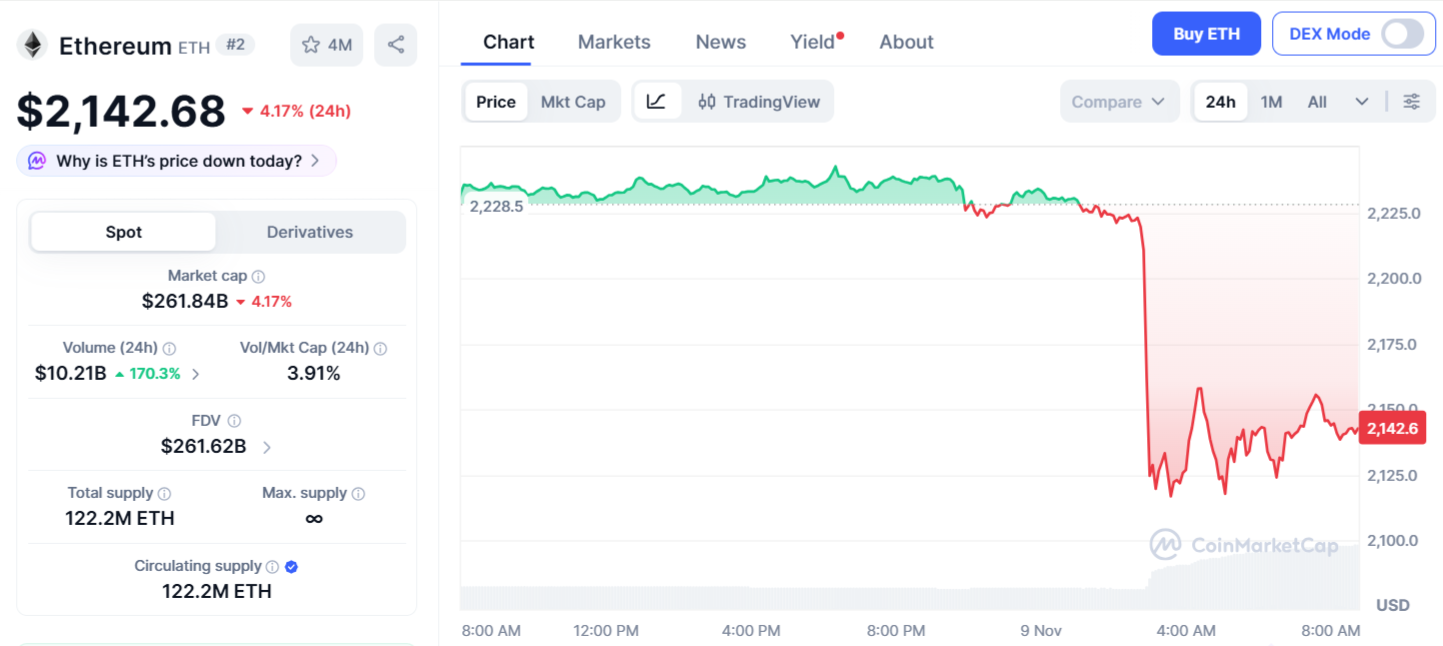
At the time of writing, ETH was trading at $2,142, down 4.17% over the past 24 hours, according to CoinMarketCap. The drop coincided with the market’s overall crypto slump, significant liquidations, and ongoing withdrawals from US spot Ethereum ETFs.

eToro Platform
Best Crypto Exchange
- Over 90 top cryptos to trade
- Regulated by top-tier entities
- User-friendly trading app
- 30+ million users

eToro is a multi-asset investment platform. The value of your investments may go up or down. Your capital is at risk. Don’t invest unless you’re prepared to lose all the money you invest. This is a high-risk investment, and you should not expect to be protected if something goes wrong.
Advertisement