
Crypto policy, regulation, and market infrastructure moved quickly across major regions last week. Governments tightened rules, firms launched new products, and institutions pushed deeper into digital assets. At the same time, enforcement actions and security risks kept pressure on the sector. In this article, we will discuss major developments that made headlines across the crypto market over the past week.
Trump Backs a Wider US Crypto Push
President Donald Trump said the United States will become the world’s top crypto center. Trump called America a future Bitcoin superpower. He also said public demand for crypto payments keeps rising fast. He argued that Washington must stay ahead while digital assets gain broader political support across markets.
Advertisement

Trump also tied that vision to policy action. He said his administration signed the GENIUS Act into law, framing stablecoin rules as a major win for American leadership. He also warned that China wants control of the sector, urging faster U.S. action across crypto markets.
David Sacks Moves Into Broader Tech Role
David Sacks said he has left his White House role as AI and crypto czar. However, he said procedure, not politics, drove the change. His special government employee status allowed only 130 working days. Once that limit ended, he had to step down from the official post in Washington.
According to Bloomberg, White House tech advisor David Sacks said he has ended his tenure as the “AI and crypto czar” due to the time limit of his role as a special government employee; he will transition to co-chair of the President’s Council of Advisors on Science and… pic.twitter.com/HV9u9rlfzO
— Wu Blockchain (@WuBlockchain) March 27, 2026
For now, Sacks will remain active in policy. He now serves as co-chair of the President’s Council of Advisors on Science and Technology (PCAST) and focuses on artificial intelligence. The council will study economic effects, jobs, national security, and future technology recommendations.
Binance Australia Faces Major Compliance Penalty
Australia’s Federal Court ordered Binance Australia Derivatives to pay A$10 million. The case centered on serious onboarding failures for derivatives customers. ASIC said the platform misclassified many retail users. As a result, those clients accessed risky products without key protections or proper review before approval.
The company admitted users could retake a multiple-choice test until passing. Moreover, ASIC said staff did not carefully verify supporting documents. One client even gained professional status through an unsupported claim. Therefore, regulators argued the firm failed to act efficiently, honestly, and fairly during onboarding.
Stablecoin Yield Limits Stir Fresh Senate Tension
The new language in the CLARITY Act draft would block payments for simply holding stablecoins. Instead, only activity-based rewards would remain. The language still leaves uncertainty around how those reward structures may work.
Coinbase, however, firmly rejected that compromise during Senate talks. The exchange said the proposal restricts incentives and adds data limits. As a result, lawmakers now face continued pressure from both banks and crypto firms.
Britain Moves to Restrict Crypto Political Funding
The UK government plans to ban crypto donations to political groups until the rules become strong enough. It will also cap annual donations from overseas electors at £100,000 under broader election law reforms.
JUST IN: UK politics move to ban crypto donations under Starmer government.
If implemented, this could curb political funding channels for crypto interests and shift donor dynamics. $BTC $ETH
— Bpay News (@bpaynews) March 25, 2026
The measures follow recommendations from the Rycroft Review. Parties are also required to return non-compliant funds within 30 days. Officials said the plan targets untraceable money and foreign financial influence in politics.
Mortgage Rules Begin to Recognize Crypto Reserves
Better Home & Finance and Coinbase launched a related mortgage product. This offering lets buyers pledge crypto holdings for a Fannie-backed mortgage. The move follows orders from the FHFA to Fannie Mae and Freddie Mac to prepare plans that treat crypto as a reserve asset last year. Eligible holdings must sit on US-regulated centralized exchanges during mortgage risk reviews.
Hostplus Explores Crypto Inside Retirement Options
Hostplus, one of Australia’s biggest pension funds, is considering crypto exposure for members. The fund manages more than AUD 150 billion in assets. Moreover, executives said the review focuses on Bitcoin and other digital assets through the ChoicePlus option. That platform lets members manage part of their retirement portfolios directly.
ChoicePlus now represents about one percent of the fund’s total assets. Still, the review signals that major retirement institutions keep testing digital asset demand. Chief Investment Officer Sam Sicilia said the fund continues to assess the opportunity.
Tether Moves Toward Its First Full Audit
Tether announced that it signed a cooperation agreement with a Big Four accounting firm for its first audit. The review will cover reserves, liabilities, and broader financial reporting systems around USDT.
Tether has selected KPMG to conduct a full audit of its approximately $185 billion USDT reserves and hired PwC to prepare its internal systems. The move comes as Tether plans a U.S. expansion and seeks to raise $15–20 billion amid investor concerns over pricing and regulatory… pic.twitter.com/4VG5zN0Bx5
— Wu Blockchain (@WuBlockchain) March 27, 2026
KPMG will handle the full audit, while PwC will prepare internal systems. This process will go beyond the monthly attestation work from BDO Italia. Therefore, auditors will review assets, liabilities, controls, and reporting systems together. Tether said the wider review aims to improve transparency and compliance.
Morgan Stanley Ignites a Fresh ETF Fee Battle
Morgan Stanley proposed a 0.14% fee for its planned spot Bitcoin ETF. If approved, that rate would undercut all current rivals and open a new phase in the cost war. Bloomberg analyst Eric Balchunas said the pricing could help advisers choose the fund. Coinbase will handle custody and brokerage, while BNY Mellon will manage administration, transfer functions, and cash custody.
Ethereum Foundation Refines Layer One and Two Vision
The Ethereum Foundation said Layer 1 will remain a global settlement and DeFi hub. At the same time, it said Layer 2 networks now need differentiated roles beyond pure scaling. The foundation encouraged rollups to meet Stage 1 security standards and keep advancing toward stronger models.
The foundation also pledged continued work on Layer 1 capacity and blob storage. It said the current blob use remains far below full capacity. Therefore, scaling work will continue while developers address cross-chain fragmentation.
Solana Launches New Platform for Institutions
The Solana Foundation launched the Solana Developer Platform for enterprises and financial institutions. The API-based system supports product building across issuance, payments, and, later, trading modules on Solana.
Introducing Solana Developer Platform
Designed for enterprise, launch financial products on @Solana in weeks instead of months.
Create stablecoins, RWAs, or orchestrate payments with AI-ready APIs that bundle 20+ infra providers.@Mastercard, @WesternUnion, and @Worldpay are… pic.twitter.com/u02ZCDfYlw
— Solana Foundation (@SolanaFndn) March 24, 2026
The issuance and payment tools are already live. The trading module is anticipated to be released later in 2026. Mastercard, Worldpay, and Western Union have joined as early adopters of the platform.
Franklin Templeton and Ondo Expand Tokenized ETFs
Franklin Templeton partnered with Ondo Finance to launch tokenized ETF products. The structure allows round-the-clock trading through crypto wallets without requiring a brokerage account for access to those instruments. The first rollout will target Europe, Asia Pacific, the Middle East, and Latin America. Meanwhile, a US launch depends on regulation. Ondo will issue tokens that provide economic exposure through SPV.
Canada Revisits a Ban on Crypto Donations
Canada’s Parliament is reviewing Bill C-25, which would ban political donations made in cryptocurrencies. The proposal covers parties, candidates, associations, and third parties involved in election advertising activities. Lawmakers cited transparency concerns tied to crypto’s pseudo-anonymity. Moreover, the bill would fine violators twice the value of improper contributions. This marks a second attempt after a similar earlier bill failed.
BitMine Launches its Ethereum Staking Network
BitMine launched MAVAN, its institutional Ethereum staking platform, after first building it for internal use. The company now plans to serve custodians, exchanges, and larger investors through the same network.
MAVAN is live ‼️
We are open for business and will be the world’s largest single entity staking operation.
PS: you can stake your ethereum and other crypto with us. $BMNR
@fundstrat
https://t.co/SKTGJmeQTw— Bitmine (NYSE-BMNR) $ETH (@BitMNR) March 25, 2026
The firm said MAVAN already holds more than 3.1 million ETH. Chairman Tom Lee said BitMine will expand into proof-of-stake networks and blockchain infrastructure over the coming year as well.
Brazil Expands Powers to Seize Criminal Crypto
Brazil’s new anti-organized-crime law gives judges wider authority over digital assets tied to crime. Courts can freeze, manage, and seize crypto holdings when investigations show strong supporting evidence. The law also allows broader restrictions on payment services, platforms, and transfers. Moreover, judges may approve early sales of seized assets. Because crypto prices move quickly, authorities now have more flexibility before final convictions arrive.
Ripple Tests RLUSD in Singapore Trade Finance
Ripple is testing RLUSD in a Singapore central bank-backed sandbox through Project BLOOM. The pilot studies whether stablecoins and tokenized liabilities can speed up trade finance payments between businesses. Ripple is working with Unloq on the trial. Their system links trade conditions with blockchain settlement. As a result, payments could trigger automatically after shipment checks or other agreed business milestones.
Metaplanet Unveils Bitcoin Rewards for Shareholders
Metaplanet said it will launch a Bitcoin rewards card for shareholders this summer. The card will offer 1.6% back in Bitcoin on spending, linking everyday purchases with shareholder benefits. Meanwhile, the card fits inside a broader rewards program announced earlier in March. Shareholders must hold at least 100 shares by June 30. Moreover, longer-term holders qualify for stronger tiered benefits.
CFTC Forms New Unit for Emerging Markets
The CFTC launched an Innovation Task Force to address crypto, artificial intelligence, blockchain, and prediction markets. Chairman Michael S. Selig said clearer rules should support responsible growth and competitiveness.
Excited to lead the new @CFTC Innovation Task Force.
Under @ChairmanSelig, the ITF will provide clarity to builders by advancing the @CFTC’s innovation agenda across crypto, AI, & PMs.
Clear rules of the road will ensure the new frontier of finance is built in the US 🇺🇸 https://t.co/Dipu0lcMaI
— Michael Passalacqua (@passalacqua_mj) March 24, 2026
Michael J. Passalacqua will lead the effort. Meanwhile, the unit will work alongside the agency’s Innovation Advisory Committee. Officials want faster policy coordination as event contracts face more legal scrutiny.
Strategy Continues Accumulation Amid Market Downturn
Between March 16 and March 22, Strategy purchased 1,031 Bitcoin at a cost of $76.6 million. This acquisition brought its holdings to 762, 099 BTC, despite the prices still falling below its average total cost. The purchase was mainly financed by the sale of common stocks. It also increased the number of at-the-market programs for future fundraising. Strategy further stressed long-term accumulation rather than short-term market vulnerability.
ZachXBT Links Panic Accounts to Token Schemes
A coordinated X network was used to create attention using war-related panic posts, according to blockchain investigator ZachXBT. Once they reached the target, the accounts were reportedly transitioned to fake giveaways and direct token promotion campaigns. The operators purchased older accounts that had followers rather than creating new ones. Additionally, the synchronized reposting boosted visibility. Following the exposure of the network scam, the eleven accounts allegedly blocked the investigator simultaneously.
World Raises Funds Through OTC Token Sales
The World Foundation reported over-the-counter sales totaling 65 million in WLD sales. Four counterparties participated, and settlement was initiated on March 20 via World Assets, Ltd. The fund noted that the funds will be used to fund operations, research, infrastructure, and orb production. Meanwhile, the $25 million in tokens is still locked up under a six-month lock-up, which restricts some immediate supply pressure.
1/ World Assets, Ltd. has now closed a series of OTC sales for a total of $65,000,000 with four counterparties over the past week, the first of which settled on March 20, 2026.
— World Foundation (@worldcoinfnd) March 28, 2026
BNP Paribas Adds Crypto ETNs for France
BNP Paribas launched six crypto-linked exchange-traded notes for retail clients in France. The products track Bitcoin and Ether and sit inside standard securities accounts rather than private wallets. The launch gives investors regulated exposure without direct token custody. However, ETNs still carry issuer credit risk. The bank may later extend access to wealth management clients outside France.
CertiK Warns of Rising Losses Across Crypto
Blockchain security firm CertiK said crypto losses in 2026 have moved close to $500 million already. The firm recorded more than 100 security incidents and dozens of phishing scams since the year began. Meanwhile, phishing, smart contract exploits, and social engineering drove most damage. CertiK listed Step Finance, Truebit, Resolv, Swapnet, and YieldBlox among the most affected projects.
Britain Sanctions a Crypto-linked Scam Marketplace
The UK sanctioned Xinbi Guarantee for its role in laundering funds tied to scams. Officials said the platform supports romance fraud, pig butchering schemes, and broader criminal financial activity. Authorities said Xinbi connects buyers and sellers of illegal services through escrow-like tools. Even after leaving Telegram, it continued operating elsewhere.
🚨 The @FCDOGovUK has sanctioned Xinbi, a massive Chinese-language "guarantee marketplace" that processed ~$20B in illicit transactions since 2021. Xinbi is a central hub for pig butchering & investment scams and money laundering. Dive into the on-chain data behind Xinbi:… pic.twitter.com/CSNNitRqR9
— Chainalysis (@chainalysis) March 26, 2026
White House Clears Path for Crypto In 401(k)s
The White House cleared a procedural step for a Labor Department rule on 401(k) investments. The proposal could allow retirement plans to include cryptocurrency and private equity options. The Office of Information and Regulatory Affairs (OIRA) completed its review on March 24, allowing the proposal to move toward public comment. Officials want updated retirement access with safeguards, while managers still wait for clearer guidance.
Digital Asset Investment Products Market Overview
Digital asset funds posted their first weekly outflows in five weeks, losing $414 million, as per CoinShares’ latest report. Rising fears over the Iran conflict unsettled markets. At the same time, June FOMC expectations shifted toward rate hikes, resulting in the assets under management falling to $129 billion.
The United States led the retreat with $445 million in outflows. Switzerland also recorded small withdrawals of $4 million. Meanwhile, investors in Germany and Canada bought the dip, adding $21.2 million and $15.9 million, respectively.
Digital assets recorded their first outflows in five weeks ($414m) amidst the Iran conflict. 👀 pic.twitter.com/FmJzATshoO
— Crypto Crib (@Crypto_Crib_) March 30, 2026
Ethereum faced the steepest losses, with $222 million leaving funds. Its year-to-date total now stands at negative $273 million. Bitcoin also lost $194 million, yet it still holds $964 million year-to-date. XRP gained $15.8 million, while short-bitcoin products added $4 million.
Bitcoin Price Performance
The leading asset, Bitcoin, took another hit last week as the price dropped from highs of $72K to $65K. This decline erased the gains recorded when the asset hit new monthly highs recently. BTC is now down by 1% on the weekly chart, despite a 6% monthly gain. As of this writing, the price is hovering around $67,378, with a market capitalization of $1.34 trillion.
Looking at BTC’s weekly chart, the asset continues to trade inside a descending pattern. The price has tried to break out from this downtrend but has failed as the bears hold the ground tight.
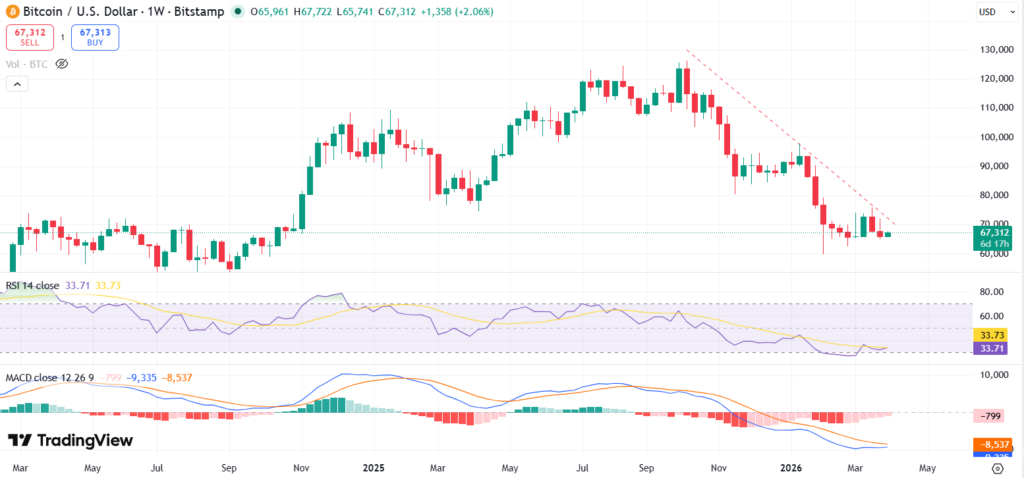
Technical indicators such as the Relative Strength Index and Moving Average Convergence Divergence still lie in negative territories. The 14-day RSI reads a value of 33, slightly above the oversold region, while the MACD line is trending below the signal line, indicating a robust bearish sentiment. Should the current trend hold further, BTC could correct further downwards toward the support regions around the $62K and $60K regions.

eToro Platform
Best Crypto Exchange
- Over 90 top cryptos to trade
- Regulated by top-tier entities
- User-friendly trading app
- 30+ million users

eToro is a multi-asset investment platform. The value of your investments may go up or down. Your capital is at risk. Don’t invest unless you’re prepared to lose all the money you invest. This is a high-risk investment, and you should not expect to be protected if something goes wrong.
Advertisement