Crypto Weekly Market Wrap December 8: SEC Innovation Plans, Global Regulation, and Market Growth

Cryptocurrency trading is speculative and your capital is at risk when you trade. We may earn affiliate commissions from some of the products on this page - at no extra cost to you.

Last week, the crypto market witnessed significant regulatory shifts, major security incidents, and strategic institutional moves. From the SEC’s proposed innovation exemption to Bank of America’s crypto portfolio advice, global momentum surged. Meanwhile, exploits at Yearn Finance and USPD reminded investors of ongoing vulnerabilities in the decentralized finance platforms. In this article, we will cover major developments that headlined the crypto market last week.
SEC Plans New Crypto Exemption to Boost Innovation
The U.S. SEC plans to establish a new crypto-oriented “innovation exemption.” SEC Chairman Paul Atkins confirmed that the announcement would be made within a month. He noted that there were delays as a result of the previous government shutdown. But now that the operations are back on track, the SEC seeks to change its historically conservative strategy. Furthermore, the agency intends to conduct broader policy changes to enhance the IPO environment next year.
Advertisement

UK Recognizes Crypto as Legal Property
The UK passed a new law that ascertained the legal status of digital assets. Cryptocurrencies and stablecoins are recognized as secure personal property under the Digital Assets and Other Property Act. It became official, as Royal Assent was granted by King Charles III. The law addresses the right to ownership, bankruptcy, and inheritance of digital property. Regulators estimate that approximately 12% of adults in the UK own crypto assets.
Update – this Bill is now on the way to the King's desk for Royal Consent and will shortly become law. See thread for some extra details👇
A hugely significant step for English law and for UK citizens who use Bitcoin.@bitcoinpolicyuk have been supporting this since the Law… https://t.co/ZbBdK59yZi
— Freddie New (@freddienew) December 2, 2025
Cross-Chain Bridge Launched by Base and Solana
Base launched a cross-chain bridge that supports two-way asset flow with Solana. It relies on custom oracles of Chainlink CCIP to verify messages securely. Transaction validation is also supported by Coinbase nodes. Users are able to move SPL assets to Base apps and trade on platforms such as Zora and Aerodrome. The developers now have unhindered access to incorporate SOL-based tokens.
Yearn Finance Faces $9 Million Exploit
Yearn Finance was a victim of a critical exploit to its yETH pool. Through an undisclosed vulnerability, attackers were minting yETH and emptied the pool. They walked away with about 1,000 ETH, with some of it being sent to Tornado Cash. On-chain analysis showed that several smart contracts were self-destructed after execution. Messages that had been posing as white hat negotiations were disseminated after the attack, although they were identified as false by experts.
With the assistance of partner teams, Yearn has since managed to recover approximately $2.39 million worth of assets. They promised their users that any money recovered would be returned to affected depositors. The protocol advised users to watch out for fake recovery accounts claiming to be of the official team.
USPD Breached Using Proxy Attack, Tokens Illegally Minted
By deploying a malicious proxy, hackers exploited the USPD protocol. This enabled unauthorized access and admin rights prior to the public launch. Approximately 98 million USPD tokens had been minted and 232 stETH stolen. The attack employed a technique known as “Clandestine Proxy in the Middle of Proxy or CPIMP.”
🚨 URGENT SECURITY ALERT: USPD PROTOCOL EXPLOIT 🚨
1/ We have confirmed a critical exploit of the USPD protocol resulting in unauthorized minting and liquidity draining.
Please DO NOT buy USPD. Revoke all approvals immediately.
— USPD.IO | The Dollar of the Decentralized Nation (@USPD_io) December 4, 2025
The USPD team explained that there were no flaws in the core contract code. Law enforcement and exchanges were informed, and the protocol offered a 10% bounty in case the hacker returns 90% of the money. Recovery operations and investigations are ongoing.
Bank of America Introduces Crypto in Portfolio Advice
Bank of America currently recommends a crypto allocation between 1% and 4% of assets to crypto. This is the first official crypto recommendation by the bank. It is applicable to Merrill, Merrill Edge, and Private Bank platforms. Since January 2026, BofA will cover research on leading Bitcoin ETFs. These include the IBIT of BlackRock and the FBTC of Fidelity.
This is a significant change because in the past, advisors were not allowed to recommend crypto. Crypto is now a part of traditional portfolios, as it has 15,000 advisors on board under regulated instructions.
Ethereum Implements Fusaka Upgrade
Ethereum completed its Fusaka upgrade, which improved Layer 1 scalability. The update added the Blob Parameter Only fork to handle rollup demand. It augmented the capacity of blobs, improved cost-efficiency, and enhanced user experience. Fusaka is a key component of the long-term roadmap at Ethereum.
Binance Appoints Yi He as Co-CEO
Yi He was officially named co-CEO of Binance, alongside Richard Teng. Yi, a co-founder, had long been involved in internal management duties. The announcement was made at Binance Blockchain Week as user numbers approached 300 million. The new management team will enhance innovation, regulation, and international business growth. Moreover, Binance confirmed that Yi He will now assume a more public-facing executive position.
Russia to Ease Crypto Rules Before Year-End
A new policy is being prepared by the Bank of Russia to relax crypto restrictions. Authorities are contemplating the relaxation of regulations restricting access to super-qualified investors. Global payment challenges have increased, and broader access through crypto is under consideration. The policy will treat digital assets as regular financial tools.
JUST IN: 🇷🇺 Bank of Russia confirms it’s discussing easing cryptocurrency regulations – Cryptopolitan. pic.twitter.com/uneKDSwOen
— Whale Insider (@WhaleInsider) December 2, 2025
Additionally, another framework is anticipated before year-end. Regulators propose that the next wave of regulation will expand the legal use beyond niche investors.
South Korea to Allow Bank-Led Stablecoin Issuers
Lawmakers in South Korea are finalizing a new digital asset bill. The plan requires stablecoin issuers to be bank-led consortia that have a majority of 51% financial control. This trend aligns with the position of the Bank of Korea to retain issuance in the banking system.
The involvement of fintech in the country has been previously supported by some members of the National Assembly. The new dominant strategy, however, is focused on regulated banks. This bill is likely to undergo the legislative process this month and will be ready before January.
Pakistan Advances National Crypto Regulation
The Ministry of Finance in Pakistan conducted a high-level meeting to develop its digital asset framework. The meeting featured senior banking executives and Binance CEO Richard Teng. There is a proposal to have a tiered licensing system of Virtual Asset Service Providers. This is aimed at achieving global standards, safeguarding investors, and improving institutional trust. The new structure will furthermore facilitate the local and international cryptocurrency operators with stringent regulation.
Kyrgyzstan Launches Gold-Backed Stablecoin
Kyrgyzstan launched USDKG, a gold-backed stablecoin pegged to the U.S. dollar. The coin was introduced on the Tron blockchain and will be expanded to Ethereum. USDKG is issued by a state-affiliated corporation, which meets the law and audit standards. The project was verified by ConsenSys Diligence, becoming the first state-controlled stablecoin in Central Asia. The issuance is fully secured with physical gold reserves of up to $50 million.
Malaysia Fights Power Theft from Illegal Bitcoin Mining
Since 2020, Malaysia has uncovered 14,000 mining locations of illegal crypto. These locations had stolen more than $1.1 billion of electricity from the national grid. The operations utilized the mobile setups, which were hard to detect. Energy officials said that power theft posed a threat to the stability of the grid.
Moreover, the government introduced a combined task force of drones and police to fight the problem. Already, almost 3,000 cases have been registered this year alone, as mining boomed with crypto price gains.
VTB to Launch Direct Crypto Trading by 2026
Russia’s VTB Bank intends to introduce direct crypto trading services in 2026. The bank already provides crypto derivatives but is now shifting to spot trading. Investors will purchase and sell tokens such as Bitcoin directly using brokerage accounts.
JUST IN: 🇷🇺 Russia's second-largest bank, VTB, set to launch #Bitcoin & crypto trading in 2026.
Russia is coming 🚀 pic.twitter.com/oCHVOYCVEd
— Bitcoin Magazine (@BitcoinMagazine) December 4, 2025
In addition, the launch will be in accordance with the new Russian crypto regulations. According to VTB, the move will increase market transparency and link brokers with custodial services.
HashKey Clears Hong Kong Exchange Listing Hurdle
HashKey passed its listing hearing in the Hong Kong Stock Exchange. It plans to issue an IPO upon HKEX approval. Between 2022 and 2024, the revenues increased sharply, reaching HK$721 million this year. By August, the company held more than HK 2.2 billion of liquid and digital assets. The IPO is sponsored by major banks such as JPMorgan Chase. HashKey has already revealed financials and is going to initiate its public listing process soon.
Upbit Mandates New Deposit Addresses After Hack
Upbit reset all deposit addresses following the $36 million security breach. Users are now required to generate new addresses prior to reusing the platform again. The exchange is rebuilding its wallet system to eliminate risks. The process is closely monitored by regulators because Upbit has been upholding its infrastructure to security standards. The reset would be a major milestone in deterring future attacks.
Coinbase Collaborates with Major U.S. Banks
Coinbase is collaborating on crypto pilots with some of the major U.S. banks. CEO Brian Armstrong confirmed that the areas of focus comprise custody, stablecoins, and trading. Banks such as Citi and JPMorgan are already collaborating with Coinbase on projects, although they are not named.
🇺🇸BIG BANKS IN TALKS WITH COINBASE
Armstrong reveals major U.S. banks are partnering with #Coinbase for stablecoin payments, crypto custody, and trading integrations. pic.twitter.com/l01C9Mqsej
— Coin Bureau (@coinbureau) December 3, 2025
The pilot programs are supposed to integrate blockchain solutions with traditional finance. Armstrong further pointed out that early adoption provides a competitive advantage to the banks.
Celsius Prepares Massive Creditor Payout
Celsius Network is prepared to distribute a total of $476 million. This is the highest payout the company has paid out. A new Tether repayment increased net assets to $531 million. Operations are allocated about $55 million. However, an additional $579 million is held up in litigation. Further repayments will take place after claims have been cleared.
CoinShares Refutes Tether Insolvency Concerns
CoinShares rejected emerging questions regarding the financial stability of Tether. Arthur Hayes and S&P Global had raised the concerns. A senior researcher at CoinShares pointed out the surplus of $6.8 billion in Tether’s reserves. According to him, the attestation report on the stablecoin indicates solvency. Although Bitcoin and gold positions are volatile, CoinShares can see no evidence of systematic risk. Moreover, they believe that Tether is financially stable in its existing form.
Strategy Sets Aside $1.44 Billion in Bitcoin Dividend Reserve
Strategy disclosed a reserve of $1.44 billion to cover stock dividends and debt interest. Finance was raised through an equity offering. The company holds more than 650,000 Bitcoins, which constitute approximately 3.1% of the global supply. The company claimed that it would not sell Bitcoin unless the financing options failed. In the event of a decline in market value, it may consider a controlled sell-off. However, the best path is long-term holding.
Do Kwon Faces Prison for Terra Collapse
U.S. prosecutors are requesting a 12-year sentence against Do Kwon in the Terra and Luna collapse. Kwon had already admitted guilt to conspiracy and wire fraud charges. His actions, according to the authorities, caused broader market failures.
U.S. prosecutors have asked a New York federal judge to sentence Terraform Labs co-founder Do Kwon to 12 years in prison, calling his role in the 2022 TerraUSD collapse a “colossal” fraud that triggered broader crypto-market failures, including the downfall of FTX. Sentencing is…
— Wu Blockchain (@WuBlockchain) December 5, 2025
According to the court filing, his misconduct resulted in more losses than other high-profile crypto executives. The prosecutors require him to pay over $19 million in illicit proceeds.
Italy Warns Crypto Firms on MiCA Compliance
The financial regulator in Italy issued a timeframe within which crypto companies must comply with MiCA regulations. Companies have to be registered by December 30, 2025. Unregistered providers will be required to close down and forfeit customer assets. The firms that submit their applications in time will be allowed to operate during the review period, but not beyond June 2026. The authorities also advised the users to confirm the compliance of their provider with official EU lists.
CFTC Approves Spot Crypto Trading on U.S. Exchanges
Spot trading of cryptocurrencies in registered exchanges was officially authorized by the CFTC. This is a historic step that will bring federal regulation of digital asset markets. The acting chair, Caroline Pham, remarked that now-listed spot products are subject to high regulatory standards. Furthermore, this is based on recommendations from the Presidential Digital Asset Working Group. This change allows spot crypto to be legally supported in the U.S. commodity regulations.
Digital Asset Investment Products Market Overview
The latest report by CoinShares shows that digital asset exchange-traded products (ETPs) attracted $716 million last week as investor confidence improved. The assets managed increased to $180 billion, which is an increase of 7.9% compared to November. However, they are still far short of the all-time record of $264 billion.
Digital asset ETPs saw US$716m in weekly inflows, lifting total AuM to US$180bn, though still well below the US$264bn all-time high. Bitcoin attracted US$352m while XRP (US$245m) and Chainlink (US$52.8m) also saw strong demand. Short-Bitcoin products saw outflows of US$18.7m, the…
— Wu Blockchain (@WuBlockchain) December 8, 2025
There were inflows in most regions, with the United States being the leader with $483 million. Germany came in second with $96.9 million, and Canada contributed $80.7 million. These profits indicate increased involvement in digital assets on a global scale.
Bitcoin has received new inflows of investments amounting to $352 million, increasing its annual total to $27.1 billion. Meanwhile, short-Bitcoin products registered outflows of $18.7 million, which is indicative of a reduction in panic. XRP recorded inflows of $245 million, and Chainlink registered a record of $52.8 million, which is more than half the total assets.
Bitcoin Price Performance
The flagship asset, Bitcoin, experienced a positive price movement last week following a period of continuous volatility. The price rebounded from lows of $83K and rallied to face resistance at the $94K region to record a surge of over 8%. Furthermore, its market cap and trading volume climbed to $1.80 trillion and $57 billion, respectively.
Looking at the 7-day chart, BTC’s price is showing signs of reversal as it starts to print green candlesticks. The Relative Strength Index (RSI) is surging from the oversold region to the neutral region, indicating eased selling pressure.
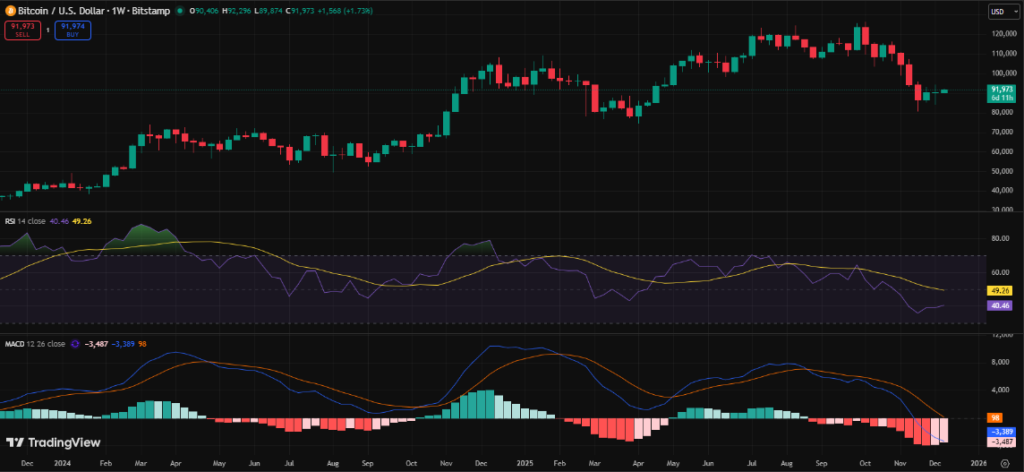
In addition, the Moving Average Convergence Divergence (MACD) is recovering from the negative region as the red bars in the histogram start to fade away. BTC could retest the immediate resistance at the $97K level should the current trend hold further.

eToro Platform
Best Crypto Exchange
- Over 90 top cryptos to trade
- Regulated by top-tier entities
- User-friendly trading app
- 30+ million users

eToro is a multi-asset investment platform. The value of your investments may go up or down. Your capital is at risk. Don’t invest unless you’re prepared to lose all the money you invest. This is a high-risk investment, and you should not expect to be protected if something goes wrong.
Advertisement