Crypto Weekly Market Wrap December 1st: Global Shakeups, Regulatory Advances, and Major Security Incidents

Cryptocurrency trading is speculative and your capital is at risk when you trade. We may earn affiliate commissions from some of the products on this page - at no extra cost to you.

Last week, the crypto market witnessed a flurry of global developments, from regulatory breakthroughs to major security breaches. Trading disruptions, new oversight frameworks, and institutional adoption shaped investor sentiment. While nations like the UK and Australia advanced digital asset regulation, incidents in Asia and corporate shifts underscored crypto’s evolving yet fragile infrastructure. In this article, we will discuss the crypto weekly market wrap of November 1st in greater detail.
CME Glitch Pauses Global Futures Trading
On November 29, a failure in a cooling system at CyrusOne affected the CME Group’s core systems. This led to CME pausing trading in all its key derivatives, such as crypto, oil, metals, and equity index futures.
Advertisement

Due to a cooling issue at CyrusOne data centers, our markets are currently halted. Support is working to resolve the issue in the near term and will advise clients of Pre-Open details as soon as they are available.
— CME Group (@CMEGroup) November 28, 2025
Just before the official halt in trading, traders were taken by surprise when quotes stopped updating. To handle risk, some brokers widened spreads or switched to internal pricing models. Others, such as CMC, halted commodity trading completely. Technical teams, however, restored services under backup procedures, and price feeds resumed shortly after.
Upbit Breach Freezes Solana Withdrawals
South Korean exchange Upbit lost $37 million to an abnormal outflow to Solana wallets. The hack occurred at 04:42 KST on November 27, and it affected more than 20 tokens, such as SOL, ORCA, and RAY.
Upbit suspended withdrawals and shifted remaining assets into cold storage. The exchange initiated a probe and also did an emergency audit of internal wallet systems, whereby they discovered a critical wallet flaw enabling private key exposure. However, they did not verify whether this vulnerability was the direct cause of the hack. Authorities are investigating connections with the Lazarus Group, which has been involved in previous attacks.
CFTC Advances Prediction Markets Oversight
CFTC Commissioner Caroline Pham announced the new CEO Innovation Council to lead frontier financial regulation. One such area is prediction markets, which are gaining more and more attention among the sectors. Pham also asked the stakeholders to nominate and suggest topics by November 25. As platforms such as Polymarket continue to grow fast, the CFTC is also urging the establishment of more explicit oversight structures to suit the growing arena.
Trump’s Fed Pick Sparks Crypto Conversation
Kevin Hassett has become the most suitable candidate as the replacement for Jerome Powell as the Federal Reserve chair. He holds a large stake in Coinbase and is considered crypto-friendly.
Here is a full clip of my 45 min interview with NEC Director Kevin Hassett, current leading candidate for Fed chair.https://t.co/iEp2eqJ7vz
— Anna Wong (@AnnaEconomist) November 27, 2025
According to treasury leaders, a decision is possible before Christmas. Hassett’s policy is also inclined towards faster rate cuts, and publicly, he has supported the idea of digital asset innovation. A new appointment would possibly change the Fed’s tone on crypto liquidity and payments.
China Reaffirms Crypto Ban Amid Rising Speculation
In a high-level meeting, the People’s Bank of China once again reiterated its national cryptocurrency ban on November 28. Authorities cautioned about the resurgence of speculation and attributed it to financial fraud and foreign transfer of funds.
Officials stressed that digital currencies have no legal tender status. Tighter monitoring and crackdown efforts were called for by the PBOC. Stablecoins were also questioned because of their inadequate adherence to AML and the risks of illegal financing.
SEC Clears Fuse Network on Token Use
The SEC issued a rare no-action letter to Fuse, a Solana-based DePIN project. The regulator indicated that Fuse would be able to issue tokens to participate in the network without labelling it as a security. Fuse described that its FUSE token is not marketed as an investment, and the token can only be redeemed through third parties. The SEC concurred, making sure that no enforcement would be enacted provided Fuse remains within the outlined parameters.
UK Mandates Crypto Trader Reporting
As of January 1, 2026, the UK-based crypto traders will be required to provide personal information to websites. The new regulations fall under the OECD Cryptoasset Reporting Framework. HMRC will obtain the tax identification numbers and the transaction records of users. The goal would be to enhance transparency in taxation and conform to anti-evasion strategies across international borders.
🚨UK TO TRACK ALL CRYPTO TRADES
🇬🇧 Starting Jan 1, 2026, exchanges must collect all UK users’ transaction data and send it to HMRC in 2027.
This will help HMRC check tax returns and stop crypto tax evasion. pic.twitter.com/ymyLqMEhng
— Coin Bureau (@coinbureau) November 29, 2025
Visa Expands USDC Settlements Across Emerging Markets
Visa expanded its stablecoin settlement services to Central and Eastern Europe, the Middle East, and Africa. The growth involves USDC via its collaboration with the infrastructure partner Aquanow. The system facilitates 365-day processing of transactions for local Visa partners. This move positions Visa to broaden the usage of stablecoins in global finance.
Kazakhstan Considers Large Crypto Reserve Investment
The National Bank of Kazakhstan is considering a $300 million investment in crypto assets. According to Timur Suleimenov, the funds would be raised through foreign reserves but not through the national fund.
Suleimenov noted that the volatility of the markets has reduced the pace of making decisions. He stressed a cautious strategy and added that they would wait for stable entry points. Kazakhstan previously supported the Alem Crypto Fund and has increasingly been interested in digital finance.
Turkmenistan Approves Digital Asset Regulation Act
Turkmenistan enacted a law that will come into effect on January 1, 2026. The act clarifies storage, use, circulation, and legal attributes of the crypto assets. It proposes the exchanges and mining firm licensing requirements and mandates the identity verification and cold asset storage. The government is seeking to draw in investment and diversify the economic approach beyond natural gas export. The bill prohibits mining operations to ensure transparency within institutional involvement.
Animoca Brands to Focus on Stablecoins and RWA
Animoca Brands plans to increase its contribution in the field of stablecoin and real-world asset tokenization. Keyvan Peymani, chief strategy officer, stated plans to forge into these sectors. The firm intends to implement a new business channel, the RWA marketplace, in order to expand utility and create additional business segments.
Animoca Brands to Expand Beyond Gaming, Eyes Stablecoins, AI and DePIN@animocabrands plans to expand its portfolio beyond gaming in 2026, targeting sectors such as AI, DePIN, DeFi, RWAs and stablecoins, said CSO Keyvan Peymani in a CNBC interview. Gaming remains its largest… pic.twitter.com/2W9Z4r1Ptr
— ME (@MetaEraHK) November 28, 2025
The developers have observed the growing appeal of tokenized equivalents of traditional commodities and financial products. Stablecoin infrastructure is also one of the main growth sources of the Web3 initiatives.
Bitcoin Mining Quietly Resurges in China
Bitcoin mining in China has reemerged again with surplus energy regions in the country, including Xinjiang and Sichuan, despite the nationwide ban brought in 2021. The Hashrate Index indicates that the nation currently controls about 14% of the world’s mining capacity. There are reports that project this figure to be up to 20%. According to the operators, mining would last as long as there is cheap energy. New projects obtain the right to construct, quietly, exploiting low electric rates to restore competitiveness again.
Japan to Enforce Exchange Liability Reserves
The Japanese Financial Services Agency plans to require digital asset platforms to hold liability reserves. The measure will facilitate compensation during instances of unauthorized access or outflow. An appropriate rule will be included in a forthcoming advisory report by a working group. The growth in risk mitigation occurs after a number of world thefts. Authorities demand exchanges to abide by strengthening asset protection systems and providing new enhanced protection measures.
Australia Proposes New Digital Asset Bill
Australia introduced amendments to regulate crypto trading platforms and custodian services with respect to financial law. An AFS license would allow operators to remain in operation. High-risk platforms might receive an exemption provided the cap on assets per customer does not exceed AUD 5,000, and the volume of transactions per year does not exceed AUD 10 million.
Australia Moves to Regulate Crypto Platforms Under New Consumer – Protection Law
The new framework subjects exchanges and custody providers to financial services laws with ASIC as the primary regulator.#bitcoin #ethereum
— Insider.Space (@InsiderDotSpace) November 27, 2025
The bill makes ASIC the primary regulator and would match digital platforms with traditional financial oversight standards. Lawmakers seek to minimize the ambiguity in compliance and enhance the protection of investors.
South Africa Flags Regulatory Gaps
In its latest stability report, the South African Reserve Bank cautioned that incomplete frameworks of crypto and stablecoin pose macroeconomic risks. Digital assets allow cross-border movement even without exchange control rules. The authorities plan to revise the rules to incorporate such dealings under official oversight.
The Ministry of Finance, in conjunction with SARB, helps in defining new compliance procedures. Authorities are aiming at long-term financial risk management but recognize the blistering development of digital markets.
Spain Plans Major Crypto Tax Increase
The Sumar group of Spain suggested taxing gains of crypto assets in the tax base in general, with tax rates as high as 47%. Existing taxes are classified as the savings regime with a limit of 30%. Businesses would also be taxed 30% on gains under the change. The motion further requires risk disclosure labels and expansion of asset seizure laws to include all types of crypto. Legislators are looking to expand accountability to defy the tendency of speculation.
Securitize Gains Dual Regulatory Clearance
Securitize, a tokenization platform, received full EU authorization to run a digital securities system. It is now authorized in both the United States and the European Union. The company supports tokenized security trading and settlement. With the backing of BlackRock and Ark Invest, Securitize seeks to bridge traditional and digital finance.
MoonPay Wins New York Trust Charter
MoonPay has been licensed to offer crypto custody by the New York Trust Charter. The license enables it to protect assets and provide direct over-the-counter services. Under regulatory safeguards, customers are now able to trade even outside centralized exchanges. The company will focus on enhancing institutional confidence in crypto-trading.
🗽 MoonPay is now authorized by NYDFS to operate MoonPay Trust Company in New York!
🍎 this expanded regulatory footprint unlocks digital asset custody and OTC trading for our financial infrastructure
🚀 NY BitLicense + Trust Charter = a new era of compliant innovation pic.twitter.com/LtTuZuxY1k
— MoonPay 🟣 (@moonpay) November 25, 2025
Polymarket Approved for U.S. Prediction Market Access
The CFTC granted Polymarket an amended order, permitting it to conduct business in the U.S. It can now collaborate with brokers and FCMs. Moreover, the platform is capable of providing intermediated access and operating under regulated derivatives platforms. The approval marks a turning point in forecasting markets in the U.S.
UK Opens Live Stablecoin Testing Program
The UK FCA introduced a new cohort of stablecoin testing with access to a live market. The participating firms will be operating in a regulatory sandbox environment. Applicants will contribute to creating regulations on stablecoins and will receive support from regulators. The UK aims to be a global leader in digital finance innovation.
Report Claims Trump Family Gained Billions from Crypto
According to a new congressional report, the Trump family leveraged the presidency to make billions of dollars through crypto connections. The report cites regulatory rollbacks and pardons associated with friendly companies. Critics argue that the administration prioritized individual wealth over national security. The report also mentions halted investigations into influential crypto platforms.
Shiba Inu Introduces Major Privacy and AI Gaming Upgrades
Shiba Inu unveiled two significant Shibarium updates last week. The first one introduces encrypted smart contracts through Zama FHE privacy technology. The second initiates a new AI gaming collaboration with TokenPlay. The upgrades led to a minor recovery for the price following the broader market downturn.
Zama → Shibarium Privacy upgrade incoming
That means that before the end of Q2 2026, we could finally get full on chain privacy and confidential smart contracts on Shibarium and Bone thanks to Zama’s Fully Homomorphic Encryption tech. pic.twitter.com/0uc4qNZ2co
— 𝐋𝐔𝐂𝐈𝐄 (@LucieSHIB) November 27, 2025
Texas Initiates Treasury Bitcoin Allocation
Under its Strategic Bitcoin Reserve program, Texas made an initial purchase of $5 million through BlackRock IBIT ETF. Authorities allocated $10 million in total, though additional purchases are yet to be made. The state anticipates transitioning into self-custody when frameworks are completed.
The transaction came after a brief downturn in the market, with the treasury departments monitoring the price movements prior to execution. Authorities pursue the advantages of diversification, citing the long-term strategic positioning.
Tether Ends Mining Operations in Uruguay
Tether ceased its Uruguay Bitcoin mining operations, citing high electricity prices. The company informed the Ministry of Labour and plans to lay off 30 employees. The move indicates changing strategies in crypto mining due to issues of profitability.
Digital Asset Investment Products Market Overview
Digital asset exchange-traded products saw a sharp rebound last week, recording $1.07 billion in total inflows, as per the CoinShares latest report. Investors regained confidence after FOMC member John Williams hinted at possible U.S. rate cuts. The shift marked a strong turnaround following four straight weeks of outflows reaching $5.7 billion.
Digital asset ETPs recorded US$1.07bn in inflows after four weeks of heavy outflows, helped by hopes of an imminent US rate cut following comments from FOMC member John Williams. Bitcoin, Ethereum and XRP attracted strong inflows, attracting US$464m, US$309m and a record US$289m…
— Wu Blockchain (@WuBlockchain) December 1, 2025
The U.S. led with nearly $994 million despite quiet Thanksgiving trading. Canada added $97.6 million, while Switzerland drew $23.6 million. Germany moved in the opposite direction, registering outflows of about $57 million. Trading volumes dropped to $24 billion, down from the previous week’s record of $56 billion.
Bitcoin gained $461 million, reflecting renewed optimism. Ethereum attracted $308 million in inflows. XRP set a record with $289 million, while Cardano slipped with $19 million in outflows, equal to 23% of its assets.
Bitcoin Price Performance
The flagship asset, Bitcoin, saw its price rise from lows of $85K to face resistance at the $93K region last week. During that period, its market cap and trading volume declined to $1.70 trillion and $60 billion, respectively.
Looking at the weekly chart, BTC is still dropping below key levels as it failed to hold above the lower Bollinger band. This suggests that Bitcoin’s price could continue to correct further if the current trend holds.
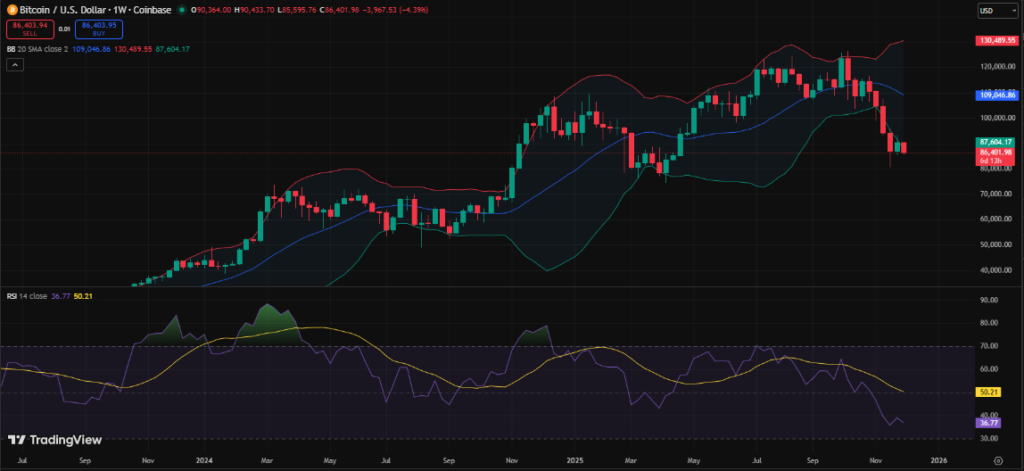
Meanwhile, the Relative Strength Index (RSI) is steadily dropping below the neutral region and has approached the oversold region at 36 levels. This sharp drop suggests that selling pressure is dominating the market.

eToro Platform
Best Crypto Exchange
- Over 90 top cryptos to trade
- Regulated by top-tier entities
- User-friendly trading app
- 30+ million users

eToro is a multi-asset investment platform. The value of your investments may go up or down. Your capital is at risk. Don’t invest unless you’re prepared to lose all the money you invest. This is a high-risk investment, and you should not expect to be protected if something goes wrong.
Advertisement