Kevin O’Leary Warns Quantum Risk Is Limiting Institutional Bitcoin Allocations

Cryptocurrency trading is speculative and your capital is at risk when you trade. We may earn affiliate commissions from some of the products on this page - at no extra cost to you.

Highlights:
- Kevin O’Leary says most institutions are limiting Bitcoin exposure to 3%.
- Harvard and Jefferies cut their Bitcoin holdings after the October decline.
- Quantum risk is influencing how funds plan their long-term Bitcoin exposure.
Kevin O’Leary, a Shark Tank investor, said investors are limiting Bitcoin exposure as quantum computing concerns enter institutional allocation discussions. He made the remarks after Bitcoin lost nearly 50% of its value since October. Portfolio committees tightened their exposure to cryptocurrencies during that period of volatility. Most large funds are restricting crypto mandates to Bitcoin and Ethereum. They no longer allocate funds broadly across smaller tokens.
Advertisement

JUST IN: Kevin O’Leary aka Mr. Wonderful says that institutions do not want to own more than 3% of Bitcoin in their portfolios because of the risk of quantum computing. pic.twitter.com/bwx5Oz8NqS
— Crypto Pump (@crypto_pump00) February 17, 2026
O’Leary noted that fund allocations are being restricted due to quantum computing risks. He said, “Until that gets resolved, don’t expect them to go beyond a 3% allocation. They’ll stay cautious, they’ll stay disciplined, and they’ll wait for clarity. That’s the reality.”
The October correction prompted portfolio reviews across traditional finance. Bitcoin declined sharply, and many altcoins fell between 80% and 90%. Many of those tokens remain well below their prior levels. Institutions reduced positions in those assets and reassessed liquidity conditions.
Institutions Narrow Crypto Exposure After October Shock
Asset managers now confine crypto allocations to core holdings. They focus on liquidity depth and secondary market stability. O’Leary said funds view Bitcoin and Ethereum as sufficient exposure to crypto volatility. Portfolio managers also incorporated the recent geopolitical developments in their risk analysis. US-Iran tensions increased uncertainty in global markets last year. Funds examined how Bitcoin traded during periods of heightened volatility. They monitored ETF flow swings and order book activity. Those findings influenced the revised position sizes that they currently hold.
Harvard reduced its stake in BlackRock’s iShares Bitcoin Trust by 21% following the downturn. Spot Bitcoin and Ethereum ETFs also recorded heavy redemptions during the correction. Large allocators adjusted exposure while reviewing internal risk parameters.
3% Portfolio Cap Signals Stricter Capital Discipline
Committees are already implementing regulated governance rules concerning exposure to digital assets. O’Leary justified that 3% was a viable threshold in the current institutional conventions. He associated the cap with volatility control and fiduciary control.
The portfolio decision by Christopher Wood, the global head of equity strategy at Jefferies, strengthened that stance. He eliminated a 10% Bitcoin allocation and cited quantum-related uncertainty. Long-horizon technological risk has become part of capital planning in institutions. They carry out scenario analyses that consider the possibility of cryptographic disruption.
Developers have introduced technical responses during this period. They introduced the Bitcoin Improvement Proposal 360 in the official repository. The proposal outlines a Pay-to-Merkle-Root structure that removes the quantum-vulnerable key path spend. Meanwhile, Bitget introduced the UEX Security Standard with BlockSec to strengthen exchange safeguards.
BIP 360: Pay to Merkle Root
was published pic.twitter.com/GXkmTHnDoL
— Murch (@murchandamus) February 11, 2026
In a related event, Michael Saylor announced that Strategy launched a Bitcoin security initiative with the global cyber, crypto, and Bitcoin security community to address quantum computing and future threats.
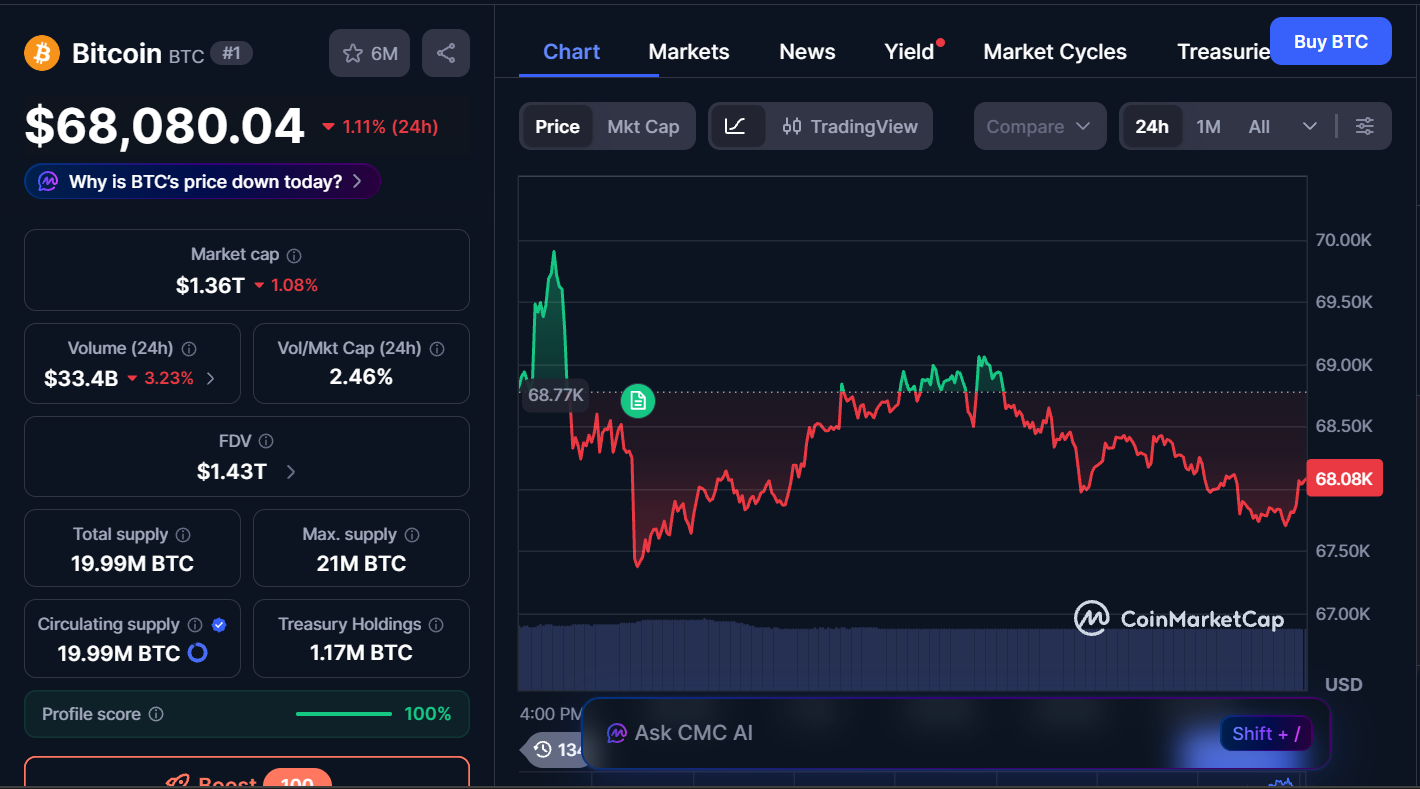
The BTC price fell 1.11% in the past 24 hours, with the price currently trading at $68,080. In addition, the trading volume is down 3.23% to $33.4 billion, while the market cap stands at $1.36 trillion.
What’s Next for BTC Amid Quantum Risk
Investment committees are now including quantum computing scenarios in their formal risk reviews. Experts estimate practical quantum capability could emerge within 10 to 15 years. No existing system can break Bitcoin encryption today. Long-horizon investors are incorporating that possibility into stress modeling and allocation frameworks. Meanwhile, developers are evaluating cryptographic safeguards while institutions are assessing technical progress before revisiting exposure limits.

eToro Platform
Best Crypto Exchange
- Over 90 top cryptos to trade
- Regulated by top-tier entities
- User-friendly trading app
- 30+ million users

eToro is a multi-asset investment platform. The value of your investments may go up or down. Your capital is at risk. Don’t invest unless you’re prepared to lose all the money you invest. This is a high-risk investment, and you should not expect to be protected if something goes wrong.
Advertisement