
Highlights:
- Canary filed an S-1 for a PEPE ETF with the Securities and Exchange Commission.
- The proposed fund would let investors track PEPE without buying or storing tokens directly.
- The filing is still early and includes strong warnings about possible investment losses.
Canary Capital Group LLC is pushing deeper into crypto investment products with a new filing tied to one of the market’s most recognizable meme coins. The firm, on Wednesday, submitted an S-1 registration statement to the U.S. Securities and Exchange Commission for the proposed Canary PEPE ETF.
Advertisement

If approved, the fund would give investors a way to track PEPE Coin through a standard brokerage account. That means they would not need to buy the token themselves, manage a crypto wallet, or deal with storage and security issues directly.
The filing adds a new angle to the growing market for crypto exchange-traded products. So far, spot Bitcoin and Ethereum ETFs have led the space. Canary’s latest move suggests that interest may now be spreading beyond major digital assets and into meme coins, with PEPE becoming an early test case.
🚨JUST IN: CANARY FILES S-1 FOR $PEPE ETF
Canary Capital, the Nashville-based firm that was first to market with an $XRP ETF and has filed for Litecoin, HBAR, SEI, MOG and more, has now filed an S-1 for a Pepe Coin ETF.
A memecoin born as a joke in 2023 now has a legitimate… pic.twitter.com/i3gTuq5FuJ
— BSCN (@BSCNews) April 8, 2026
How the Canary’s PEPE ETF Would Work
The proposed Canary PEPE ETF is built to follow the price of PEPE Coin as closely as possible. If it wins approval, the fund would hold PEPE directly and use a pricing benchmark to calculate its daily value. That benchmark would take trade data from major crypto exchanges and measure a 60-minute average price in U.S. dollars. In simple terms, if PEPE rises or falls, the ETF is expected to move in the same direction, after fees and expenses.
Investors would be able to buy and sell shares of the fund on a U.S. stock exchange the same way they trade regular stocks. Share creation and redemptions would be handled by large financial institutions known as Authorized Participants, using blocks of 10,000 shares. This is a common ETF structure and is meant to help keep the market price of the fund close to the value of the PEPE it holds.
Canary Capital would act as the sponsor and oversee the fund’s daily operations. The ETF would charge an annual fee, while Canary has also agreed to absorb ordinary expenses up to $150,000 each year.
The filing further says the trust may keep up to 5% of its assets in Ether to cover blockchain transaction fees tied to moving PEPE on Ethereum. That ETH would not be held as an investment. The overall setup remains fairly simple, with no leverage or complex derivatives involved.
The document also carries strong risk language, saying the shares are speculative securities and that investors could lose their entire investment.
Several important pieces are still left blank in the filing. Canary has not yet disclosed which exchange would list the ETF, what ticker it would use, who would provide the pricing benchmark, who would serve as custodian, or how much the sponsor fee would be.
Memecoin ETF Filings Keep Expanding
The PEPE filing adds to Canary’s wider push into high-risk crypto ETFs. The firm had also filed for other meme coin products linked to MOG and PENGU. That shows some asset managers are now testing demand beyond Bitcoin, Ethereum, and even Dogecoin.
Dogecoin is still the clearest example in this space. But Canary’s PEPE filing shows meme coins are being taken more seriously as possible exchange-traded products. Whether the SEC will approve one tied to PEPE is still unclear.
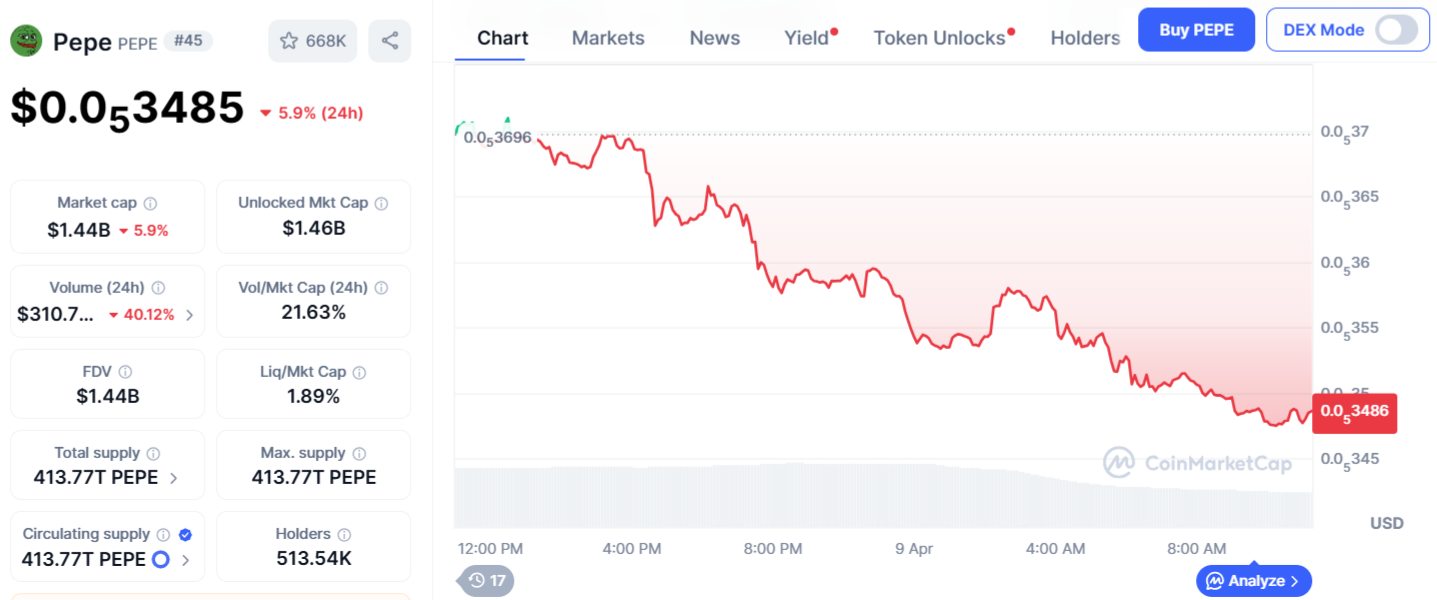
Following the recent development, PEPE has not performed well and was trading at $0.000003486, down about 6% in the past 24 hours.

eToro Platform
Best Crypto Exchange
- Over 90 top cryptos to trade
- Regulated by top-tier entities
- User-friendly trading app
- 30+ million users

eToro is a multi-asset investment platform. The value of your investments may go up or down. Your capital is at risk. Don’t invest unless you’re prepared to lose all the money you invest. This is a high-risk investment, and you should not expect to be protected if something goes wrong.
Advertisement