The crypto market last week saw a series of significant developments, from regulatory actions to investment shifts and legal victories. Notable events included President Trump’s push for regulatory clarity, legal wins for Uniswap, and new crypto laws in countries like Russia and Pakistan. Despite the ongoing geopolitical crisis, major companies like the NYSE and Binance made strategic moves in the rapidly evolving sector. In this article, we will discuss key developments that made headlines last week.
Trump Urges Quick Passage of Clarity Act
President Donald Trump criticized the banks for undermining the GENIUS Act, which he considers crucial to U.S. dominance in crypto. He stressed the need to enact the Clarity Act to ensure regulatory transparency. The GENIUS Act is essential to the U.S. becoming a global crypto hub, whereas the Clarity Act would offer it the needed regulatory certainty.
Advertisement

Trump warned that, unless the U.S. takes action, other nations, such as China, would attract crypto companies. Trump also urged banks to collaborate with the crypto industry instead of hindering its progress through legislative delays.
NYSE Parent Invests in OKX
The parent company of NYSE, Intercontinental Exchange, invested in crypto exchange OKX at a valuation of $25 billion. This investment provided the NYSE parent with a seat on the board of OKX. In return, OKX will supply real-time crypto pricing data to Intercontinental Exchange. In addition, in late 2026, OKX will launch tokenized stocks and derivatives of NYSE-listed securities.
Breaking: According to Fortune, Intercontinental Exchange (ICE), parent company of the NYSE, has invested in crypto exchange OKX at a $25 billion valuation and secured a board seat.
The investment amount and specific terms were not disclosed. In the partnership, OKX will…
— Wu Blockchain (@WuBlockchain) March 5, 2026
Uniswap Wins Legal Victory
A federal court in the United States ruled out all the allegations against Uniswap Labs and its co-founder, Hayden Adams, in a class action lawsuit. The plaintiffs claimed that the platform promoted fraudulent scheming, including drug pulls and pump-and-dump. The court, however, ruled that Uniswap only offered decentralized services and did not take part in the fraud.
The decision affirmed the legal stance that decentralized platforms have no responsibility for actions committed by independent token issuers. It is also a major win for the DeFi space and its regulatory framework in the future.
Russia to Introduce Stablecoin Legislation
Russia is working on separate legislation on stablecoins, separate from its upcoming crypto trading regulation. Director of the Ministry of Finance of Russia, Alexey Yakovlev, emphasized the significant potential of stablecoins. After the general crypto trading law is implemented, the government will introduce stablecoin regulations.
Currently, stablecoins are not defined in Russian legislation. Moreover, the new regulation will provide a more organized system of issuing and using stablecoins and will provide more transparent rules in the expanding digital assets market.
Pakistan Passes Crypto Regulation Law
The parliament of Pakistan enacted the Virtual Assets Act, creating the Pakistan Virtual Assets Regulatory Authority (PVARA). This authority will be in charge of licensing, regulating, and monitoring crypto exchanges and service providers. It also establishes standards of anti-money laundering (AML) and counter-terrorism financing (CTF).
Kazakhstan Sets Up Crypto Investment Portfolio
The National Bank of Kazakhstan established a crypto portfolio valued at up to $350 million, using its gold and foreign exchange reserves. The fund will invest in technology stocks and index funds based on crypto assets. The shift indicates the increasing interest of Kazakhstan in the inclusion of digital assets in its financial portfolio. Moreover, the plan will be officially introduced in April or May 2026, marking a new phase in the financial policy of the country.
🚨KAZAKHSTAN CENTRAL BANK TO INVEST IN CRYPTO
Kazakhstan’s central bank is allocating up to $350M from its gold and FX reserves to invest in crypto and related instruments, governor Timur Suleimanov said. pic.twitter.com/88KGn3IJrO
— Coin Bureau (@coinbureau) March 6, 2026
Binance Plans Expansion in Asia
Binance plans to obtain five new regulatory licenses in Asia this year. This growth will see its licensed jurisdictions across the world exceed 20. Binance has already received licenses in nations such as Japan, India, and Thailand. The Head of Asia-Pacific of the exchange, SB Seker, noted that the company is on the verge of obtaining regulatory approvals in a number of markets.
Strategy and Bitmine Expands Holdings
Strategy proceeded with its Bitcoin accumulation strategy, buying $200 million worth of Bitcoin. This increased its total holdings to approximately 720,750 Bitcoin, worth approximately $47 billion. The firm is determined to continue hoarding its Bitcoin reserves regardless of the fluctuations in the market. Meanwhile, another company, Bitmine, expanded its Ethereum portfolio by purchasing 51,000 ETH. The firm now owns more than 4.4 million ETH, which is approximately worth $8.8 billion.
Binance Responds to Iran Transaction Allegations
Binance denied being involved in transactions with Iranian-related organizations, as alleged in a letter by Senator Richard Blumenthal. The exchange claimed that it complies with U.S. sanctions and anti-money laundering laws. Binance noted that it constantly enhances its internal systems to eliminate unlawful transactions. The response of the company is a part of the ongoing efforts to maintain regulatory compliance. Binance also highlighted that it complies with all the requirements to avoid any violations, demonstrating its determination to meet the international standards in the crypto industry.
Justin Sun Settles SEC Allegations of Fraud
Justin Sun settled with the U.S. Securities and Exchange Commission (SEC) regarding fraud and manipulation in the market. The SEC had charged Sun and his businesses with the unregistered sale of securities and market manipulation for TRX and BTT tokens. The companies owned by Sun paid a civil penalty as part of the settlement. Although the SEC dismissed its fraud charges, the settlement requires Sun’s companies not to engage in misleading market practices.
I am very pleased to confirm that the SEC has moved to dismiss all claims against me, Tron Foundation, and BitTorrent Foundation.
Today’s resolution brings closure, but I never stopped building. I will continue to focus on accelerating innovation in the United States and around…
— H.E. Justin Sun 👨🚀 🌞 (@justinsuntron) March 5, 2026
Binance Lawsuit on Terrorism Charges Dismissed
A federal judge in New York dismissed a lawsuit accusing Binance of facilitating terrorism using its platform. The plaintiffs, victims of attacks by such groups as Hamas and ISIS, claimed that Binance facilitated the transfer of money to terrorist groups. The court, however, discovered that the plaintiffs were not able to establish that the actions by Binance enabled the attacks. Although the judge acknowledged that Binance had violated anti-money laundering laws, she noted that there was inadequate evidence that the exchange had facilitated specific terrorist activities.
First Polkadot Spot ETF Launches in U.S.
The first-ever spot Polkadot exchange-traded fund (ETF) was introduced by 21Shares in the U.S. The fund, which trades under the ticker TDOT, will allow investors to have exposure to Polkadot. The fund charges a 0.3% fee and was seeded with $11 million. The unique architecture of Polkadot enables developers to build their own blockchains and benefit from shared security.
KuCoin Ordered to Halt Services in Dubai
Dubai’s Virtual Assets Regulatory Authority (VARA) instructed KuCoin to shut down all unlicensed crypto operations within the city. The regulator discovered that KuCoin had been operating without the needed approval under Dubai’s crypto regulations. The move by VARA is part of the ongoing efforts to bring compliance in the expanding crypto economy in the region.
Dubai’s Virtual Assets Regulatory Authority (VARA) has issued an emergency alert against KuCoin.
The regulator ordered the exchange and its parent companies to immediately “cease and desist” all unlicensed activities, citing unauthorized services and misrepresentation of its… pic.twitter.com/2h2Q7KgNZW
— Crypto Wave (@Crypto_Wavee) March 6, 2026
KuCoin was charged with misinterpreting its licensing status and carrying on operations that exposed users to financial risks. This ruling of the regulator highlights the need to comply with domestic laws, especially in places such as Dubai that are tightening their crypto oversight.
Strike Secures BitLicense to Operate in New York
Bitcoin payments platform Strike was granted a BitLicense by the New York State Department of Financial Services. This license enables Strike to provide Bitcoin-related products and services like brokerage, recurring purchases, and conversion of direct deposits to its New York residents and businesses. This is a major achievement for Strike, as the BitLicense is a stringent regulatory requirement for crypto companies in New York. Furthermore, the approval finalizes the rollout of the company in all 50 states of the U.S.
Solv Protocol Suffers $2.7 Million Exploit
Solv Protocol, a decentralized finance (DeFi) platform, suffered a $2.7 million exploit on its Bitcoin-backed token vaults. The attack was based on a vulnerability in the contract employed to carry out Bitcoin Reserve Offerings (BRO), which enabled the attacker to mint excess amounts of SolvBTC. Solv Protocol committed to repay the losses of the affected users and issued a 10% bounty to the hacker. The platform also collaborated with various security companies to investigate the incident to prevent such exploits in the future.
Incident Update: BRO Vault
A limited exploit occurred in one of our BRO vaults, affecting a very small number of users (<10).
The impacted amount is 38.0474 SolvBTC.
All other vaults and user funds remain secure and unaffected. We're actively investigating with top security…
— Solv Protocol (@SolvProtocol) March 5, 2026
FBI Arrests Crypto Theft Suspect
John Daghita, a suspect in the theft of more than $46 million in cryptocurrency from the wallets of the U.S. government, was arrested by the FBI. Daghita was captured in Saint Martin after an international effort spearheaded by the U.S. and French officials. The stolen funds were associated with the seized assets during the 2016 Bitfinex hack. Daghita was arrested after ZachXBT, a blockchain researcher, had traced the stolen money.
SEC Submits Crypto Framework to White House
The U.S. Securities and Exchange Commission (SEC) submitted a framework to the White House on the application of federal securities laws to cryptocurrencies. The interpretive guidance is aimed at developing a “token taxonomy,” which will assist in clarifying which crypto assets are regarded as securities under US law.
The guidance, now being interagency reviewed, might have a significant impact on the crypto asset regulation. The SEC seeks to add more structure to the fast-changing crypto market by offering a clear understanding of how existing laws are applied to digital assets.
South Korea to Limit Crypto Exchange Ownership
South Korean regulators settled on a 20% ownership limit for major cryptocurrency exchanges. This ruling follows a lengthy consultation between the Digital Asset Task Force of the ruling Democratic Party and the Financial Services Commission. The new limit will come into effect after the end of a three-year grace period, with an exception of up to 34% ownership in certain cases.
Crypto.com Launches IRA Product
Crypto exchange Crypto.com introduced a new individual retirement account (IRA) product that enables U.S. residents to hold both stocks and cryptocurrencies in a single tax-advantaged account. The offering has Traditional and Roth IRA options and enables users to invest in a diverse array of digital assets, such as Bitcoin and Ethereum.
It’s time to redefine retirement planning.
Meet https://t.co/vCNztATkNg IRAs — the first crypto-native retirement accounts of their kind, designed for the next generation of investors.
⭐ Invest in crypto, stocks, and ETFs with tax-deferred or tax-free benefits
⭐ Get up to a… pic.twitter.com/NFrTOBUXZM— Crypto.com (@cryptocom) March 3, 2026
The new IRA product is expected to ease the process of investment for those who want to diversify their portfolios with a mix of traditional assets and digital currencies. It also facilitates lockup programs and staking to help users earn rewards within the IRA.
Visa Expands Stablecoin Card Program
Visa, partnering with Stripe-owned Bridge, launched a stablecoin-based card initiative in more than 100 countries. The cards, currently in 18 countries, enable users to spend with stablecoins from wallets such as MetaMask and Phantom. Moreover, the cards will be accepted in Visa’s global network of 175 million merchant locations.
SoFi and Mastercard to Use SoFiUSD for Payments
Mastercard and SoFi Technologies expanded their collaboration to settle with SoFiUSD, a fully reserved stablecoin, across the global payments network. The stablecoin issued by SoFi Bank will allow transactions to be settled faster, especially when it comes to cross-border remittances and B2B transactions. The partnership will also aim to enhance the interoperability of tokenized deposits, fiat currencies, and stablecoins. By integrating the SoFiUSD into Mastercard’s Multi-Token Network, both companies seek to simplify the payment process and provide more efficient alternatives to businesses and consumers.
Digital Asset Investment Products Market Overview
Last week witnessed significant inflows for digital asset investment products, amounting to $619 million, as per CoinShares’ latest report. This was fuelled by the high demand at the beginning of the week despite later outflows as oil prices increased. The initial optimism came amid geopolitical uncertainty, especially with the Iran crisis, but the sentiment dampened towards the end of the week following weak payroll data.
Digital asset investment products saw US$619m of inflows. Bitcoin dominated flows with US$521m. Ethereum and Solana attracted notable inflows at US$88.5m and US$14.6m, respectively. XRP, however, saw outflows totalling US$30.3m. https://t.co/CegXKpGij9
— Wu Blockchain (@WuBlockchain) March 9, 2026
The US spearheaded the positive sentiment and posted inflows of $646 million, whereas Europe, Asia, and Canada registered small outflows. The inflows were led by Bitcoin, which received $521 million, with Solana and Ethereum receiving notable investments, as well. However, XRP saw outflows of $30.3 million, the only significant asset that saw a significant decline. The digital asset sector was largely resilient despite market volatility, indicating the continued interest in cryptocurrencies despite uncertainty.
Bitcoin Price Performance
Bitcoin witnessed a rocky performance last week as the price surged from below $65K and climbed to $74K. This is the highest level the asset has reached in the past month after a period of volatility following the ongoing US-Iran conflict, impacting the broad crypto market. During that period, BTC recorded a gain of more than 2% as the price faced rejection, correcting below $70K again. In addition, its market capitalization and trading volume have dropped to $1.34 trillion and $40 billion, respectively.
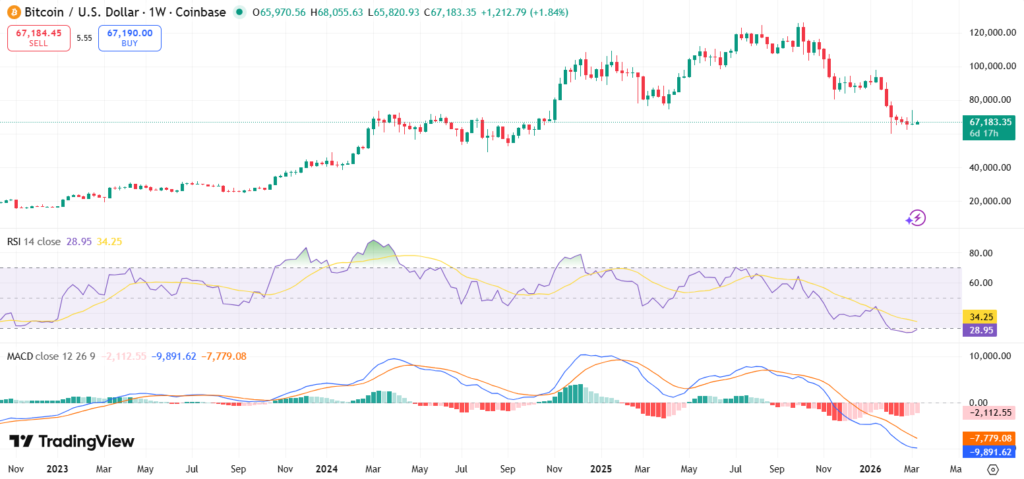
Looking at the technical indicators on the weekly chart, BTC is still trading in the negative region. The RSI is hovering around the oversold region at 28 levels. Moreover, the MACD line is below the signal line in the negative territory, indicating a bearish sentiment. Should the current trend hold further, BTC could correct further below the support situated at the $60K level.

eToro Platform
Best Crypto Exchange
- Over 90 top cryptos to trade
- Regulated by top-tier entities
- User-friendly trading app
- 30+ million users

eToro is a multi-asset investment platform. The value of your investments may go up or down. Your capital is at risk. Don’t invest unless you’re prepared to lose all the money you invest. This is a high-risk investment, and you should not expect to be protected if something goes wrong.
Advertisement