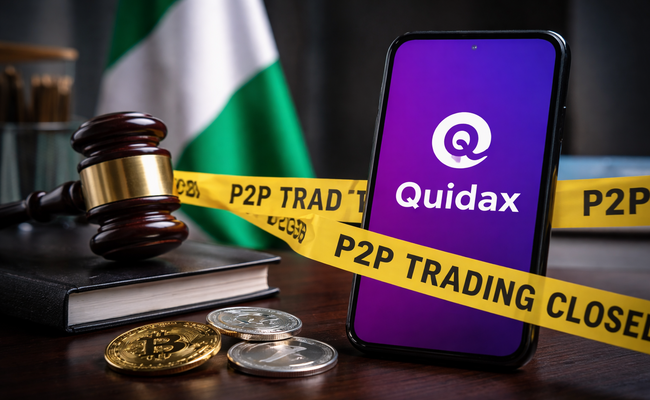
Highlights:
- Quidax has discontinued P2P trading amid regulatory pressures in Nigeria’s crypto market.
- Nigeria’s SEC is imposing stricter capital requirements for crypto service providers.
- Quidax will shift focus to higher-demand features like instant swaps and order-book trading.
Nigerian crypto exchange Quidax has announced that it is shutting down its peer-to-peer (P2P) trading feature. This move comes just five months after the platform launched the service, which enabled users to purchase and sell the crypto directly with verified vendors. The closure highlights the growing difficulties exchanges are facing in the transforming regulatory context in Nigeria.
Advertisement

Quidax’s Strategic Shift
Quidax said its move to withdraw P2P trading was a result of a strategic realignment. The exchange plans to target more in-demand capabilities like instant swaps and order-book trading. The core services, such as deposit, withdrawals, and spot trading, will proceed as usual.
Nigeria’s crypto regulation efforts face a setback as Quidax halts its P2P services.
The exchange says the move reflects user preference, not regulatory pressure.
Meanwhile, platform licensing is slowing as regulators assess market readiness.#CryptoNews #Nigeria #P2P #Blockchain pic.twitter.com/tpuJFbx65h— CoinlytX (@CoinlytX) January 25, 2026
Although the company implemented strong security measures such as rigorous Know Your Customer (KYC) protocols and two-factor authentication on P2P transactions, the controlled model of Quidax still had concerns. The SEC was concerned with the lack of transparency of transaction flows and the probability of exchange-rate manipulation. Consequently, even a closely supervised P2P model could not meet the changing regulatory environment in Nigeria.
Regulatory Pressure Intensifies
The suspension of the P2P service of Quidax follows an increase in regulatory scrutiny. The Securities and Exchange Commission (SEC) in Nigeria has been increasing regulation of the crypto sector in the country. The SEC’s Accelerated Regulatory Incubation Programme (ARIP) was intended to enable digital asset firms to transition to full licenses. Regulatory delays have, however, stalled the licensing process, leaving exchanges like Quidax in limbo.
The recent introduction of new regulations is also indicative of the hardening of the Nigerian government towards crypto trading. Those regulations treat digital assets as securities, and the platforms are subject to capital market regulations. This change is especially significant to P2P platforms, which previously have been outside of formal regulation. P2P trading models have difficulties in providing transparency of transactions and safeguarding investors, even in controlled settings.
Nigeria unveiled a major regulatory change on January 13 under the new Tax Administration Act (NTAA). The government introduced a compulsory system, which links cryptocurrency accounts to a Tax Identification Number (TIN) or National Identification Number (NIN).
Nigeria has passed a new tax law linking crypto transactions to identities via Tax Identification Numbers (TIN) and National Identity Numbers (NIN), ensuring traceability for tax purposes without compromising blockchain security. VASP are required to collect user details…
— Wu Blockchain (@WuBlockchain) January 13, 2026
Impact of Tightening Regulations on the Nigerian Crypto Ecosystem
The crypto industry in Nigeria, which was once among the most vibrant in Africa, is currently experiencing increasing regulatory limitations. Recent updates to the Investment and Securities Act (2025) by the SEC have added to the capital requirements of crypto exchanges and service providers. These regulations seek to introduce crypto operations to the same platform as traditional capital markets.
These regulations are a decisive challenge, especially to exchanges, such as Quidax, that were hoping to become fully regulated entities by 2025. The increased capital requirements and stricter regulations may reduce the number of active market participants, especially in informal channels such as P2P trading.
Quidax has also stated that it will delist 35 tokens, including certain memecoins and game-focused tokens such as Axie Infinity. The move also aligns with its strategy of concentrating on more mainstream, higher-demand features and services that are more easily regulated.

eToro Platform
Best Crypto Exchange
- Over 90 top cryptos to trade
- Regulated by top-tier entities
- User-friendly trading app
- 30+ million users

eToro is a multi-asset investment platform. The value of your investments may go up or down. Your capital is at risk. Don’t invest unless you’re prepared to lose all the money you invest. This is a high-risk investment, and you should not expect to be protected if something goes wrong.
Advertisement