
Last week was marked by significant developments in the crypto market, including legal battles over Bitcoin in both the U.S. and South Korea, to major shifts in the institutional environment. At the same time, trends are shaping globally, as Japan continues with its push into digital assets and Morgan Stanley expands in the crypto market. Here’s the breakdown.
DOJ Bitcoin Sale Raises Policy Questions
The U.S. Department of Justice faced backlash over selling 57 Bitcoins, forfeited by Samourai Wallet developers. This sale goes against an executive order that ordered forfeited Bitcoin to be transferred to the Strategic Bitcoin Reserve rather than liquidated.
Advertisement

The sale, implemented via Coinbase Prime, raised concerns about the management of Bitcoin as a strategic asset by federal agencies. Critics claim that, in case the agencies could ignore or misinterpret the executive orders, it damages the credibility of Washington in its efforts for consistent crypto policies.
South Korea’s Supreme Court Rules on Bitcoin Seizure
The Supreme Court of South Korea ruled that Bitcoin possessed by individuals in exchanges could be confiscated under the Criminal Procedure Act. The decision is based on the ruling of the Court in 2018, which stated that Bitcoin can be confiscated by the state. The Court held that Bitcoin constitutes an electronic token that has economic value. Additionally, it is controlled by the use of private keys, and, therefore, it can be seized.
🇰🇷S. KOREA: BITCOIN ON EXCHANGES CAN BE SEIZED
The South Korean Supreme Court ruled that Bitcoin held on crypto exchanges is subject to seizure under criminal law. pic.twitter.com/zcergQAYo7
— Coin Bureau (@coinbureau) January 8, 2026
The decision also broadens the application of the seizure to include not only tangible goods, but also electronic information. This establishes a precedent on the treatment of digital assets such as Bitcoin during legal proceedings.
Japan to Prioritize Digital Assets in 2026
The Finance Minister of Japan, Satsuki Katayama, declared 2026 as the “First Year of Digitalization,”. The purpose of this move is to encourage exchanges to enhance the trading environment of digital assets. Katayama highlighted the need to use exchange infrastructure to advance digital assets and blockchain. She also cited the increasing trend of ETFs as inflation hedging in the U.S., implying that Japan should follow suit to develop its digital asset ecosystem.
The Japanese government will collaborate with commodity and securities exchanges to develop digital assets. Moreover, Katayama’s comments signal that Japan is determined to increase its presence in the digital asset arena.
OKX Restructures Institutional Business
Cryptocurrency exchange OKX restructured its international institutional business. The shift led to a significant number of resignations within its institutional sales team. About a third of the staff, both through downsizing and voluntary departures, departed as part of the restructuring. The firm indicated that this shift aligns with its move towards a more traditional approach to covering institutional clients. The restructuring targets to enhance long-term relationships with institutional customers and adapt to various market cycles.
Zcash Development Team Resigns Amid Governance Dispute
Zcash core team’s the Electric Coin Company (ECC), announced their resignation. CEO Josh Swihart cited an increasing imbalance between the mission of the ECC and the governance organization, Bootstrap. The team felt that the recent decisions made by Bootstrap were not in line with the initial principles of Zcash, and thus, they decided to quit. ECC highlighted that this governance dispute would not affect the Zcash protocol itself, even though it departed. ECC later announced the release ofthe Zcash Wallet.
Over the past few weeks, it's become clear that the majority of Bootstrap board members (a 501(c)(3) nonprofit created to support Zcash by governing the Electric Coin Company), specifically Zaki Manian, Christina Garman, Alan Fairless, and Michelle Lai (ZCAM), have moved into…
— Josh Swihart 🛡 (@jswihart) January 7, 2026
Brazilian Presidential Candidate Advocates for Bitcoin Reserve
Brazilian presidential candidate Renan Santos suggested establishing a Brazilian national Bitcoin reserve. Santos believes that Bitcoin can be used to improve financial transparency in Brazil and fight corruption. Inspired by the policies of El Salvador on Bitcoin, Santos argues that by including Bitcoin in Brazil’s fiscal reserve, the country stands to boost its economy and anti-corruption efforts.
The proposal has attracted interest since Brazil already debated the possibility of adding Bitcoin to the national fiscal reserve. The campaign platform developed by Santos suggests the use of blockchain technology in the public sector to enhance transparency.
Morgan Stanley Expands into Digital Assets
Morgan Stanley expanded its digital footprint, with plans to offer crypto trading via their E*Trade platform. By the year 2026, the platform will enable the trading of Bitcoin, Ethereum, and Solana, which will be supported by Zerohash’s infrastructure. Furthermore, Morgan Stanley will introduce its own digital wallet later this year in order to facilitate tokenized assets.
Coinbase Faces Challenges Over Market Structure Bill
Coinbase could withdraw its backing of the crypto market structure bill in the U.S. This is due to the potential restrictions on stablecoin rewards. The proposed bill would restrict the ability of platforms such as Coinbase to provide incentives to stablecoin holders, which is one of the pillars of their business model. Whereas issuers of stablecoins cannot provide direct yield, platforms such as Coinbase are still permitted to offer rewards.
Coinbase Steps Up Advocacy as Crypto Bill Nears Senate Review !
Coinbase is increasing pressure on US lawmakers as a major crypto market-structure bill moves toward Senate markup, citing concerns over potential limits on stablecoin rewards. The exchange may reassess its support… pic.twitter.com/EiIvxDu3u3
— CryptoDaku (@CryptoDaku_) January 12, 2026
Coinbase is actively lobbying for these restrictions, which it perceives as harmful to the business and to the crypto market in general. The exchange believes that platform-based rewards create competition and innovation in the space.
Rumble Launches Crypto Wallet for Tipping Creators
Rumble and Tether introduced a new non-custodial crypto wallet integrated into its video streaming service. Through it, users can tip content creators directly in Bitcoin, USDT, and Tether Gold (XAUT). With MoonPay, Rumble allows transactions with the integration of cryptocurrency and traditional payment options, including credit cards and PayPal. The new wallet enables users to maintain control over their money without involving intermediaries in the tipping process.
Polymarket Faces Cease-and-Desist Orders in Tennessee
Tennessee became the first state to issue a cease-and-desist order against Polymarket. The Sports Wagering Council of the state instructed Polymarket, Kalshi, and Crypto.com to cease the promotion of sports-related event contracts to the state residents. The platforms are required to cancel existing contracts and refund customer deposits by the end of January. Non-compliance may result in escalating fines or criminal penalties.
Ripple Gains FCA Approval for UK Expansion
Ripple obtained the approval from the Financial Conduct Authority (FCA) in the UK, which facilitates its growth in the region. The license covers the Electronic Money Institution (EMI) license and registration of the crypto assets of Ripple. This new status will enable Ripple to issue digital money and payment services while adhering to the stringent anti-money laundering and know-your-customer regulations in the UK.
JUST IN: 🇬🇧 Ripple obtains registration with the Financial Conduct Authority through its UK subsidiary. pic.twitter.com/9HR7SW0fPO
— Whale Insider (@WhaleInsider) January 9, 2026
Ripple is entering the region at a time when the Financial Conduct Authority announced the introduction of a crypto licensing gateway in September this year. The move will enable crypto asset firms in the UK to seek authorization before a new regulatory framework commences in October 2027.
BNY Mellon Launches Tokenized Deposit Service
The Bank of New York Mellon (BNY Mellon) introduced a tokenized deposit service to institutional customers. The service represents a blockchain-based implementation of the traditional client deposits, which allows faster and more efficient settlements. The tokenized deposits at BNY Mellon differ from stablecoins, which are direct but interest-bearing liabilities on the issuing bank.
Rain’s Valuation Nears $2 Billion After $250 Million Series C
Rain, a stablecoin or infrastructural provider, boosted its valuation to $1.95 billion after raising $250 million in a Series C funding round. This capital will enable Rain to grow its operations and obtain licenses in different markets across the globe, such as North America and Europe.
The company is known for its stablecoin-linked Visa cards, which are now offered in more than 150 countries. Rain plans to gain more ground in these regions and still grow integrations with global payment networks such as U.S. ACH and the European SEPA network.
Vitalik Buterin Supports Tornado Cash Developer Amid Prosecution
Ethereum co-founder Vitalik Buterin expressed his support for Roman Storm, the developer of the Tornado Cash privacy tool. Storm is awaiting sentencing following a conviction on a conspiracy charge of money transmitting. Buterin claimed that the prosecution of Storm is a broader attempt at the criminalization of code and the suppression of privacy tools needed to prevent personal data leaks. He highlighted that privacy tools such as Tornado Cash play a vital role in ensuring that the financial transactions of users are not monitored.
Thank you @VitalikButerin for your principled support and for articulating exactly why privacy tools are a necessity, not a crime.
To the community: Vitalik’s voice is powerful, but yours is too. If you believe in the right to build and use open-source privacy software, please… https://t.co/UZMbMLiV6v
— Roman Storm 🇺🇸 🌪️ (@rstormsf) January 9, 2026
Buterin also framed the case as a software development attack instead of an attempt to address direct financial harm. He pointed out that Tornado Cash had been utilized to support human rights charities and purchase technical equipment without compromising privacy.
Trump Rejects Pardon for Sam Bankman-Fried
Donald Trump ruled out the possibility of pardoning the co-founder of the collapsed crypto exchange FTX, Sam Bankman-Fried. Bankman-Fried, serving a 25-year prison term on fraud and conspiracy, had requested clemency, but Trump indicated that he would not consider a pardon. The ruling follows a broader debate regarding pardoning high-profile individuals, but due to his role in one of the largest financial scandals of crypto history, SBF was a contentious case.
Colombia Requires Crypto Exchanges to Report User Data
Colombia’s tax authority, DIAN, introduced new reporting requirements for crypto exchanges and platforms. According to the new enacted Resolution 000240, such platforms are required to collect and disclose user and transaction information, such as account ownership, transaction volume, and balances. Both domestic and foreign platforms involving Colombian residents or taxpayers are subject to the rules.
The measure aligns with the OECD Crypto-Asset Reporting Framework, which advocates comprehensive reporting on cryptocurrency transactions. Colombian crypto users were already obliged to report their holdings and gains on tax returns, but this new rule is an additional control measure. Failure to comply may result in fines depending on the value of unreported transactions, and this statement further underscores the need to comply with these new regulations.
Truebit Protocol Suffers $26 Million Exploit
Truebit Protocol lost over $26 million following a major security breach. The hack was a result of an outdated smart contract, which remained linked to active liquidity pools. Attackers took advantage of the pricing error in the system to mint TRU tokens at no cost and sell them quickly, depleting the protocol’s reserves.
🚨ALERT🚨Hey @Truebitprotocol Our system has detected suspicious transaction with estimated loss of 26M!
An address got around 8,535 $ETH from "Truebit Protocol: Purchase"
More information will follow!
If you wish to safeguard yourself against such incident, please contact us to… pic.twitter.com/2AKvu1INyr— 🚨 Cyvers Alerts 🚨 (@CyversAlerts) January 8, 2026
As a result, the TRU token crashed, causing a massive panic and selling in the market. Two of the attackers were discovered by blockchain experts, one of whom extracted the majority of the stolen funds.
Florida Proposes State Bitcoin Reserve Legislation
Florida legislators proposed a bill to create a state-managed Bitcoin reserve, in which public funds could be invested in Bitcoin and other digital assets. The proposed bills, HB 183 and SB 1038, would allow up to 10% of select public funds to be invested in Bitcoin and Bitcoin-related exchange-traded funds (ETFs). Furthermore, the law enables Florida residents to utilize digital assets to pay state taxes. However, the cryptocurrency will be converted into U.S. dollars as soon as received.
CFTC Clears Bitnomial to Offer Event Contracts
The U.S. Commodity Futures Trading Commission (CFTC) granted Bitnomial Exchange a no-action letter, allowing it to offer event contracts. This approval clears the way for Bitnomial to list binary and bounded swaps referencing digital assets and financial outcomes. The CFTC’s decision was made under certain conditions. This includes the requirement for Bitnomial to publish sales data and comply with recordkeeping and reporting guidelines.
Digital Asset Investment Products Market Overview
There was a sharp shift in digital asset investment products, recording outflows of $454 million, according to the latest report by CoinShares. This decline comes after a run of outflows of more than $1.3 billion, which erased nearly $1.5 billion in inflows seen early this year. This sentiment shift seems to have been caused mainly by pessimistic expectations of a Federal Reserve rate cut in March, triggered by recent macroeconomic data.
Digital asset investment products recorded US$454 million in net outflows last week, as fading expectations for a March Federal Reserve rate cut weighed on sentiment. Bitcoin led with US$405 million in outflows, while Ethereum saw US$116 million withdrawn. In contrast, Solana,…
— Wu Blockchain (@WuBlockchain) January 12, 2026
Although the largest outflows occurred in the U.S. market at $569 million, several other nations experienced inflows. Germany, Canada, and Switzerland registered positive flows of $58.9 million, $24.5 million, and $21 million, respectively. Bitcoin suffered the most with $405 million in outflows, while Ethereum experienced withdrawals amounting to $116 million.
However, some assets remained resilient. XRP, Solana, and Sui experienced inflows of $45.8 million, $32.8 million, and $7.6 million. These shifts highlight the mixed investor sentiment in the current digital asset landscape.
Bitcoin Price Performance
The leading asset, Bitcoin, witnessed a shift in its price movement as the bullish momentum faded. Bitcoin price dropped from the highs of $94k region to seek support at around the $89k level. During this period, BTC recorded a decline of $2.30%. Moreover, its market cap and trading volume dropped to $1.80 trillion and $30 billion, respectively.
Looking at the weekly chart, BTC’s price is consolidating around the $90K level, with most of the indicators edging toward the negative territories. The RSI is hovering slightly above the oversold region at 40 levels, indicating a lack of buying pressure.
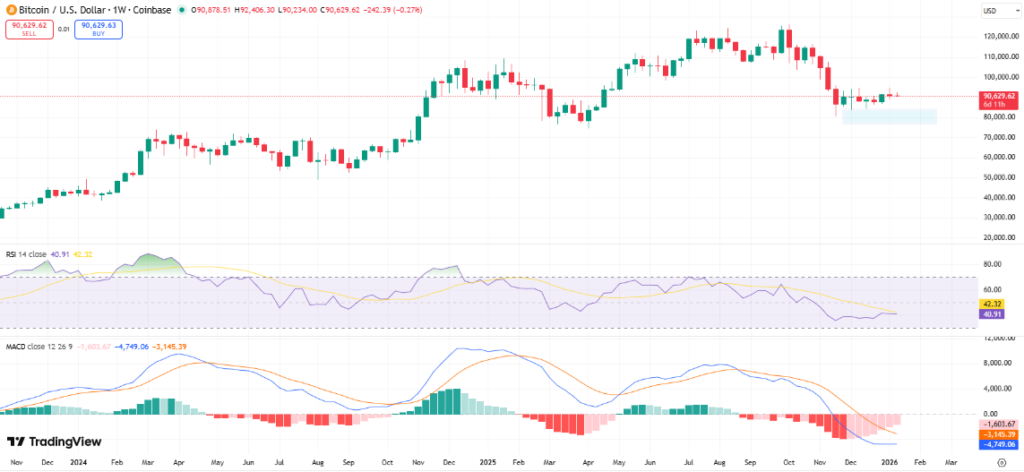
Meanwhile, the Moving Average Convergence Divergence (MACD) indicator is still negative, with signs of bearish momentum easing noted. The red bars on the histogram are fading away, which usually indicates a shift from the current trend.

eToro Platform
Best Crypto Exchange
- Over 90 top cryptos to trade
- Regulated by top-tier entities
- User-friendly trading app
- 30+ million users

eToro is a multi-asset investment platform. The value of your investments may go up or down. Your capital is at risk. Don’t invest unless you’re prepared to lose all the money you invest. This is a high-risk investment, and you should not expect to be protected if something goes wrong.
Advertisement